
Our web site is still under construction. Keep checking back for improved maps, complete walking tour directions and updated information!
Distance:
Time:
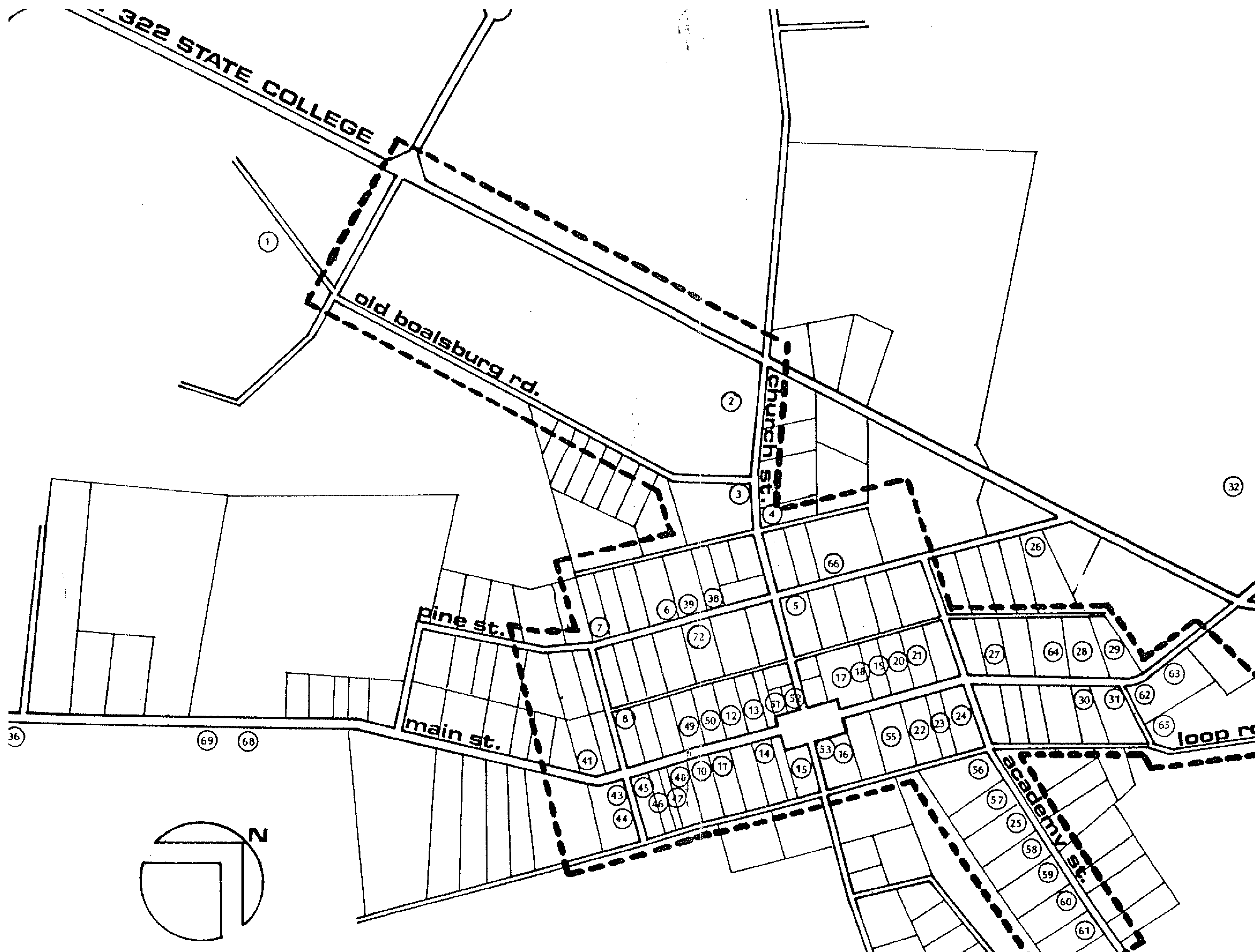
2.1 HM #14 Springfield Log House, built 1811
110 West Main Street

This house is of log construction. Built in 1811, it was one of the first houses built within the site plan for the town drawn up by Andrew Stroup in 1808. When it was built, the town name was Springfield. (The town name was changed to Boalsburg in 1820 to honor the Boal family.) The original room arrangement, windows, and random width floor boards have been preserved.
2.2 HM #13 Joseph Swinehart House, built 1820
111 West Main Street
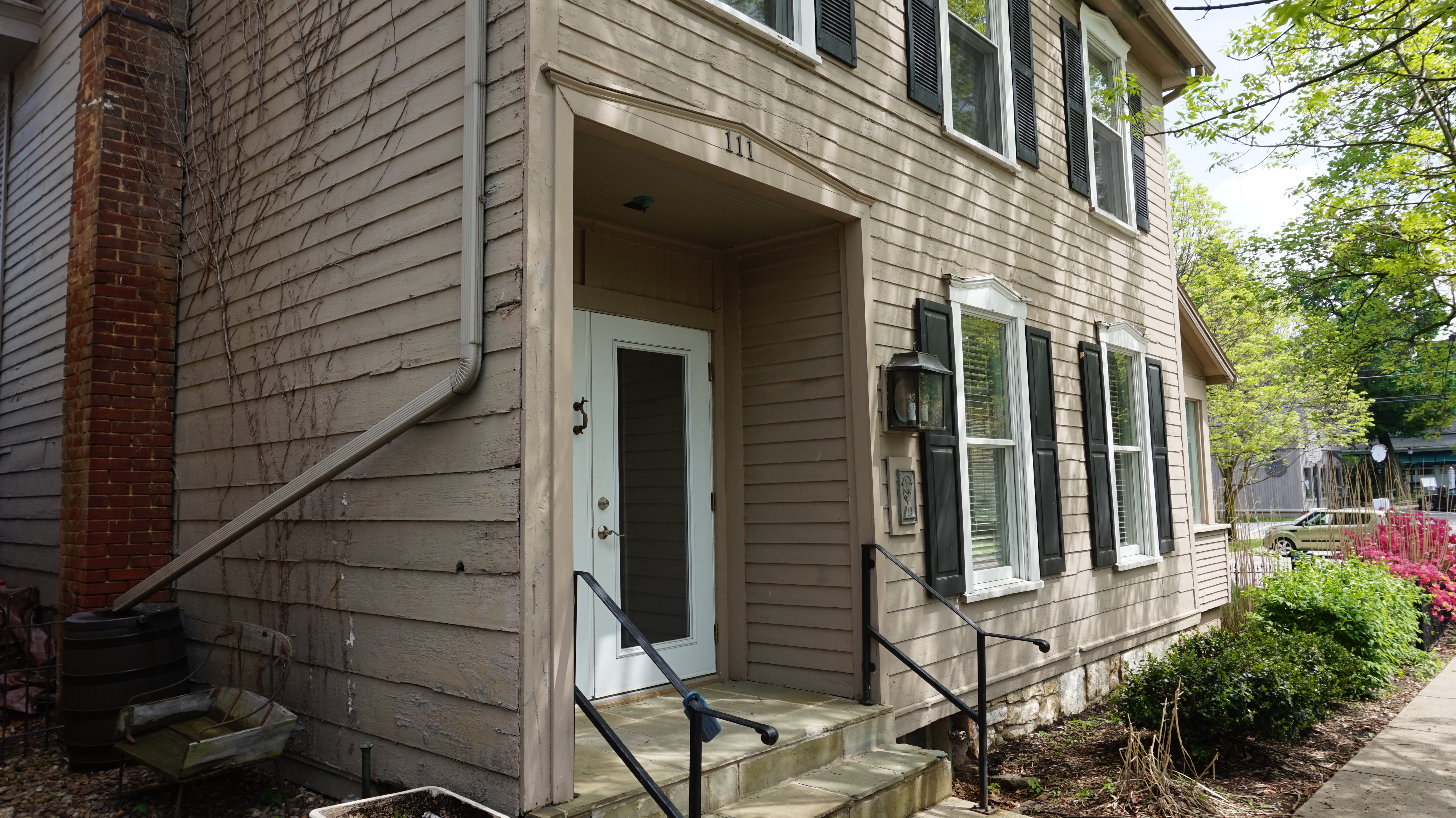
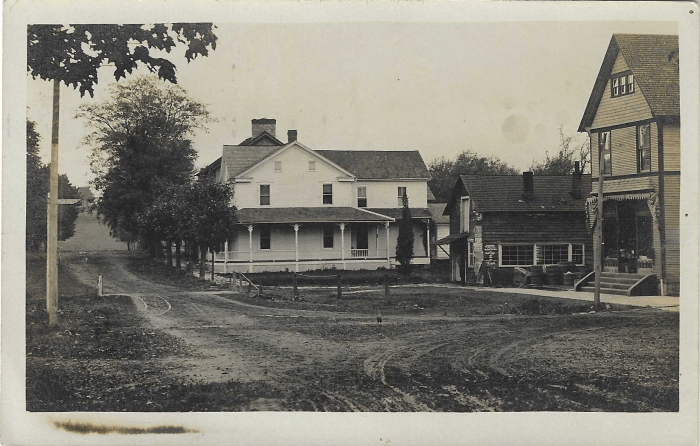
This house was built by Cornelius Dale in 1820. Joseph Swinehart, a blacksmith and coachmaker by trade, purchased this property in 1845. In addition to this property, he owned the adjoining lot to the east (HM#51), where he had his wagon shop. Joseph and his wife, Maria, left the house to the Zion Lutheran Church (HM#2) in 1872, which used it as a parsonage until 1967.
2.3 HM #12 Peter Ruble – Stone House, built between 1814-1825
115 West Main Street

Andrew Stroup sold this lot to George Stroup in 1809, who in turn sold it to Peter Ruble. This Federal style stone house was constructed sometime between 1814 and 1825 by Peter Ruble, a retiree from Potter Township. Federal style ornamentation is evident in the fine dentil molding and punch-work designs on the cornice and door. The limestone and masonry, as well as style of construction (thick 18-24 inch walls to which plaster was directly applied), are similar to that of the Boalsburg (Duffy’s) Tavern, which suggests that this house may have been built about the same time as the Tavern (ca. 1819) by the same stone mason.
2.4 HM #50 Grange Hall, built ca. 1880’s
117 West Main Street

The original structure on this lot was a one-story shop for J. N. Dinges (“Uncle Jerry”) who operated a drugstore and penny candy shop here in the 1880’s. After Mr. Dinges died in 1908, the Grand Order of the Knights of Malta purchased the property and added a second floor for their meeting room. The first floor continued to be rented as a store, including a drug store and ice cream parlor.
When a quarry blast destroyed the meeting hall of a nearby grange* (Victor Grange in Oak Hall), that grange rented space in this building from the Knights of Malta. Eventually, once the Knights of Malta were no longer active, that organization sold the property to Victor Grange.
*Granges (officially, National Grange of the Order of Patrons of Husbandry) were fraternal organizations for American farmers that encouraged farm families to work together for their common economic and political advantage. Founded in 1867 after the Civil War, it is the oldest surviving agricultural organization in the US, though now much diminished from the over one million members it had at its peak in the 1890s through the 1950s. [History 302W paper.]
2.5 HM #11 David Swinehart & Jacob Condo Blacksmith Shop, built ca. 1830
120 West Main Street

This property changed hands many times before a house was constructed ca. 1830-1832 by David Swinehart. It is a three-bay log structure. By the turn of the century, deed records indicate that there was a carriage house or stable, blacksmith shop and a smokehouse, in addition to the main house on the property. Of the many subsequent owners, two were blacksmiths, Peter Keichline and Jacob Condo. An 1874 map of Boalsburg (Atlas of Centre County, Pomeroy & Co., Philadelphia, PA) indicates that J. Condo was the owner and that there was also a blacksmith shop on the property. One of the unique features of this house is ironwork fixtures made by the blacksmiths that resided here.
2.6 HM #49 John Bricker – Ice Cream Parlor, build date unknown
121 West Main Street
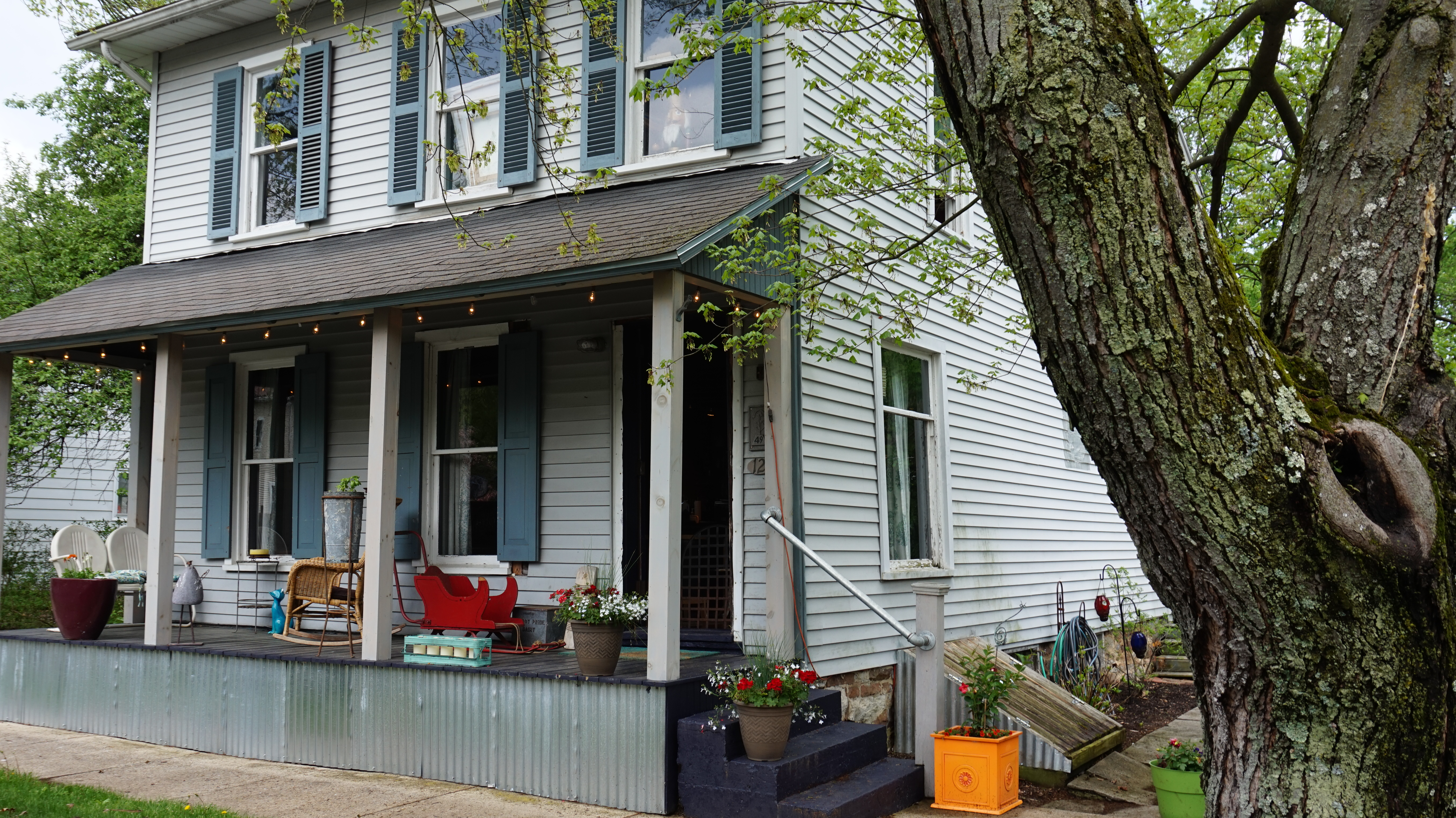
When George Boal sold this property to Augustus and Lydia Smith Wolf (or Wolfe) in 1811, there was already a house and stables listed on the property, making this one of the earliest homes within Andrew Stroup’s 1808 site plan for the village. An 1874 map of Boalsburg (Atlas of Centre County, Pomeroy & Co., Philadelphia, PA) shows that it was owned by J. C. Bricker at that time. John Bricker operated a shoe shop and later an ice cream parlor.
One interesting feature of this old home is the chimney which serves three fireplaces – one in the basement, another in the dining room, and the third in an upstairs bedroom. Their separate chimneys (and flues) become a single one on the third floor. This is an unusual arrangement, generally not done because it would lead to back-drafting. Usually in a stacked fireplace arrangement, each fireplace would have a separate flue (with a separate chimney pot at roof level), even if they shared the same chimney.
2.7 HM #10 West Main Brick House, built ca. 1830
124 West Main Street

Several brick houses appear to have been built in Boalsburg in the early 1830s, suggesting that someone may have started a brick making industry in the area at that time, or perhaps just reflecting their popularity at the time. A deed transfer in 1838 indicates that “a two-story brick house and frame plastered kitchen attached” had been erected sometime prior to that date. It is thought to be the first brick house constructed on the west side of the Diamond. The brick on the front of the house was laid in a decorative Flemish bond pattern of alternating headers and stretchers in the same row, while the rest of the house is done in a variation of the English garden wall bond. The English garden wall bond is usually done with three rows of stretchers in between rows of headers. In this case, there are five rows of stretchers between the rows of headers. This may be an indication that the owner (or builder) was trying to save a bit on building costs, since laying stretchers uses fewer bricks than laying headers.
A two story addition was added between 1846 and 1867 by the owner at that time, Reverend L. E. Secrist. After adding that addition, Reverend Secrist sold the property for $1440, a very good price in those days. In 1870, it was owned by David Sparr, a retired farmer. He lived here for a few years, and then moved to another house and rented this one. In 1899, the property was sold to Almira and Lucretia Goheen (sisters) for $600. This low sales price (less than half of the value it sold for in 1867) may reflect a loss in value due to lack of upkeep as a rental, or it may reflect the general economic decline that descended upon Boalsburg by the turn of the century when the Industrial Revolution was causing a decrease in demand for local handmade goods, and factories were drawing workers away to jobs in big cities.
2.8 HM #48 Condo House – blacksmiths, build date unknown
128 West Main Street

An 1874 map (Atlas of Centre County, Pomeroy & Co., Philadelphia, PA), shows this home as belonging to Israel Condo. The Condo brothers (Robert, Israel & Jacob) were all blacksmiths. Jacob Condo had a home and blacksmith shop just a few doors further down the street from Israel (HM#11). Robert Condo purchased the blacksmith shop originally owned by Joseph Swinehart (HM#51) where the brothers fitted rims on heavy wagon wheels.
2.9 HM #47 John Sechler – Shoemaker, build date rear brick portion prior to 1850
132 W. Main Street
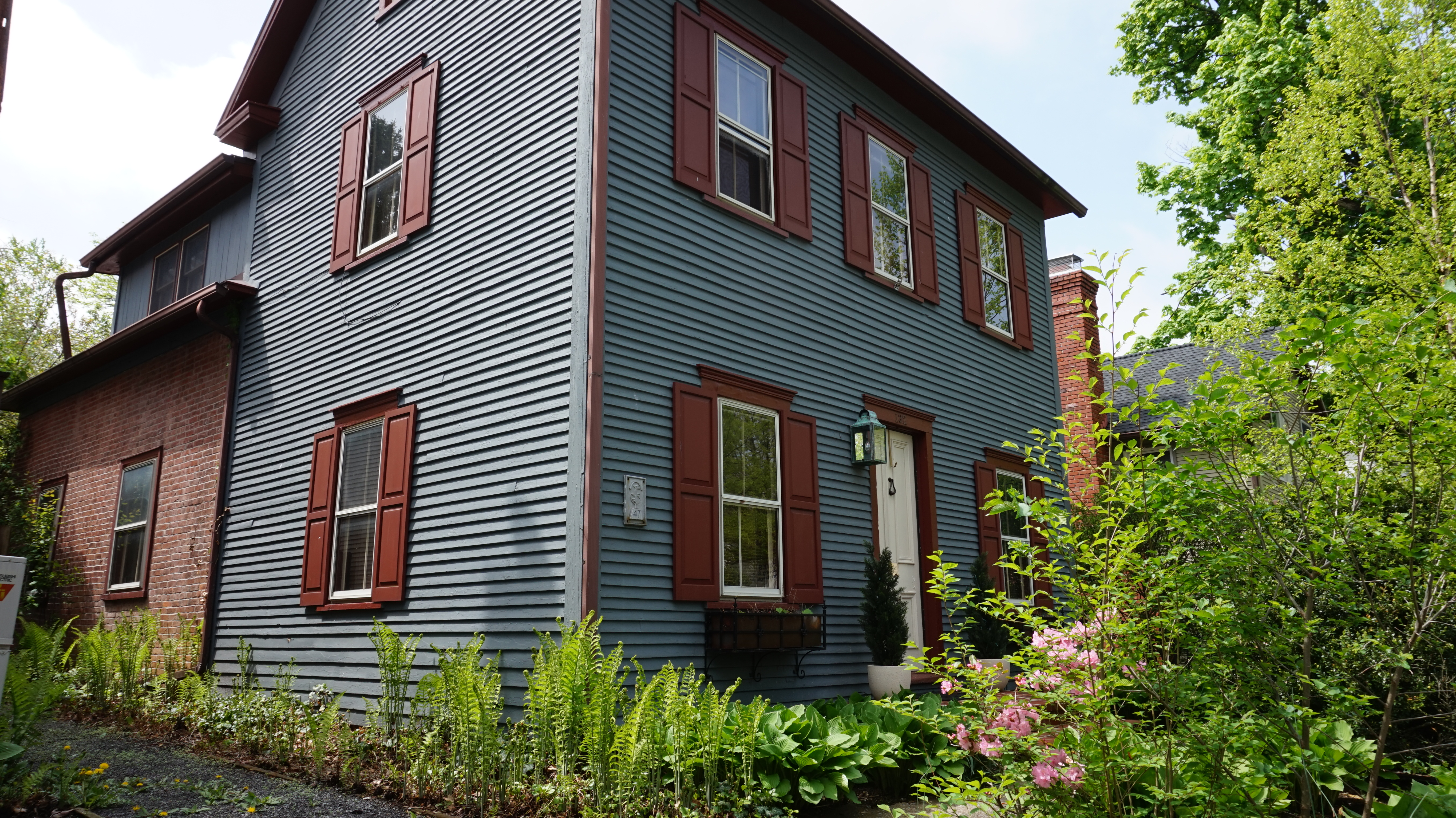
An early owner of this house was John “Daddy” Sechler, a shoemaker who purchased the property in 1858. The original dwelling was a small brick 15’ X 15’ structure with a large fireplace (the rear portion of the current house). The two-storey frame addition was added sometime after 1895. It’s not known whether Mr. Sechler had his shop on this property. However, the property was later sold to another shoemaker, Thomas Riley (1877 – 1895), so perhaps a shoe-making shop was somewhere on the property. Both shoemakers undoubtedly acquired the leather for their shoes from the tannery at the east end of town (now the Boalsburg Heritage Museum property, HM #62).
2.10 HM #46 Feed Store, ca. 1850
134 W. Main Street

This 1 ½ story house was originally part of the property at 132 W. Main St. (HM #47). It may have been one of the “outbuildings” listed on a property deed in 1850. However, the description of a “frame store house stable”, which is almost certainly a reference to this structure, does not appear until a deed in 1895. The property was purchased in 1858 by a shoemaker, John “Daddy” Sechler, who lived in a 1 ½ story brick house on the property (the back portion of HM #47) and may have used this building (or another outbuilding on the property) as his shop. Sechler sold the property to another shoemaker, Thomas Riley, in 1877. By 1923, the building was being used as a feed store (owned by Ed and Edith Lucas, operated by Mr. Ream). The long lintel above the front door is most likely a relic from a wide sliding door on the front of that store.
Prior to being converted to a residence, this building had no heat and no stairway; there was a ladder up to the attic. Massive hand-hewn beams support the structure over a stone foundation. The original flooring, foot-wide yellow pine planks, is still in place. Mid-century, an oil furnace was added in the basement crawlspace to provide heat via a large, open floor grate on the first floor. A staircase was added, as well. Extensive renovations were done in 1990, adding duct-work, double pane windows, and an addition to the rear. The fireplace and chimney were added at that time. The three decorative window panes above the front door had been boarded over sometime mid-century and were “discovered” during the 1990 renovations. An iron stabilizing rod through the width of the house had to be added to keep the walls from bowing further outward; the iron star bolts on the ends of that rod are now covered by clapboard siding.
2.11 HM #73 Tin Foundry & Shop, built ca. 1897 (original part)
135 West Main Street
In 1890, this property was sold at public auction for $180 to the Boalsburg Lodge (I.O.O.F. 894). The lodge then sold the property to S.M. (Sammy) Bell in 1897. (Mr. Bell also owned the Wolf Tavern next door, which he purchased around 1894.) Sammy Bell was a tinsmith by trade. Mr. Bell built a small tin foundry on the eastern side of the property and used a small structure on the property as his shop. The shop building (the original portion of the current home) was moved here from Linden Hall where it had been used as a lumber office. It measured 12 feet by 12 feet and had a half story sleeping loft above. The structure sat on six stone piles for support.
Over a period of about 100 years, additions were made to the original building to the front, to the back and above. Around 1900, a foundation was dug and a living room and a full second floor were added to the front of the original structure. The sleeping loft area was enlarged to a full story. In 1954, a small lean-to room was added to the back. A two-story addition was built in 2004.
[Source: Excerpt from Penn State History 302W student paper]
2.12 hm #8 Wolfe Tavern, ca. 1835
137 West Main Street

Peter Wolf (or Wolfe) purchased this property in 1834 from James Johnston (who built the Boalsburg Tavern, HM17). His son, Augustus (Angus) Wolf (wife, Margaret) operated a tavern here starting in 1835. This tavern was never in competition with the Boalsburg Tavern, because it catered to livestock drovers. There were large pens for livestock behind the tavern, and across the street was a livery for the horses. [The current house across the street (HM#45) was not built until ca. 1900.] Augustus’s youngest son, Emmanuel (wife, Leah), was a tinsmith, and the small addition on the east side of the building was built for Emmanuel’s tin shop. Emmanuel took over as tavern owner when his parents died, but he was also the town constable, so he ran a dry establishment (a hotel, rather than tavern).
Later owners of the building, William and Helen Riley Tennis, ran a general store here starting in the 1930’s – one of the last to operate in town. Many of the items remaining in the store when it closed (in 1974) were donated to the Boalsburg Heritage Museum (HM#62) by the Tennis family. Those items became the basis for the general store exhibit at the museum.
2.13 hm#45 Wolfe Tavern Livery/ brouse house, ca. 1900
138 West Main Street
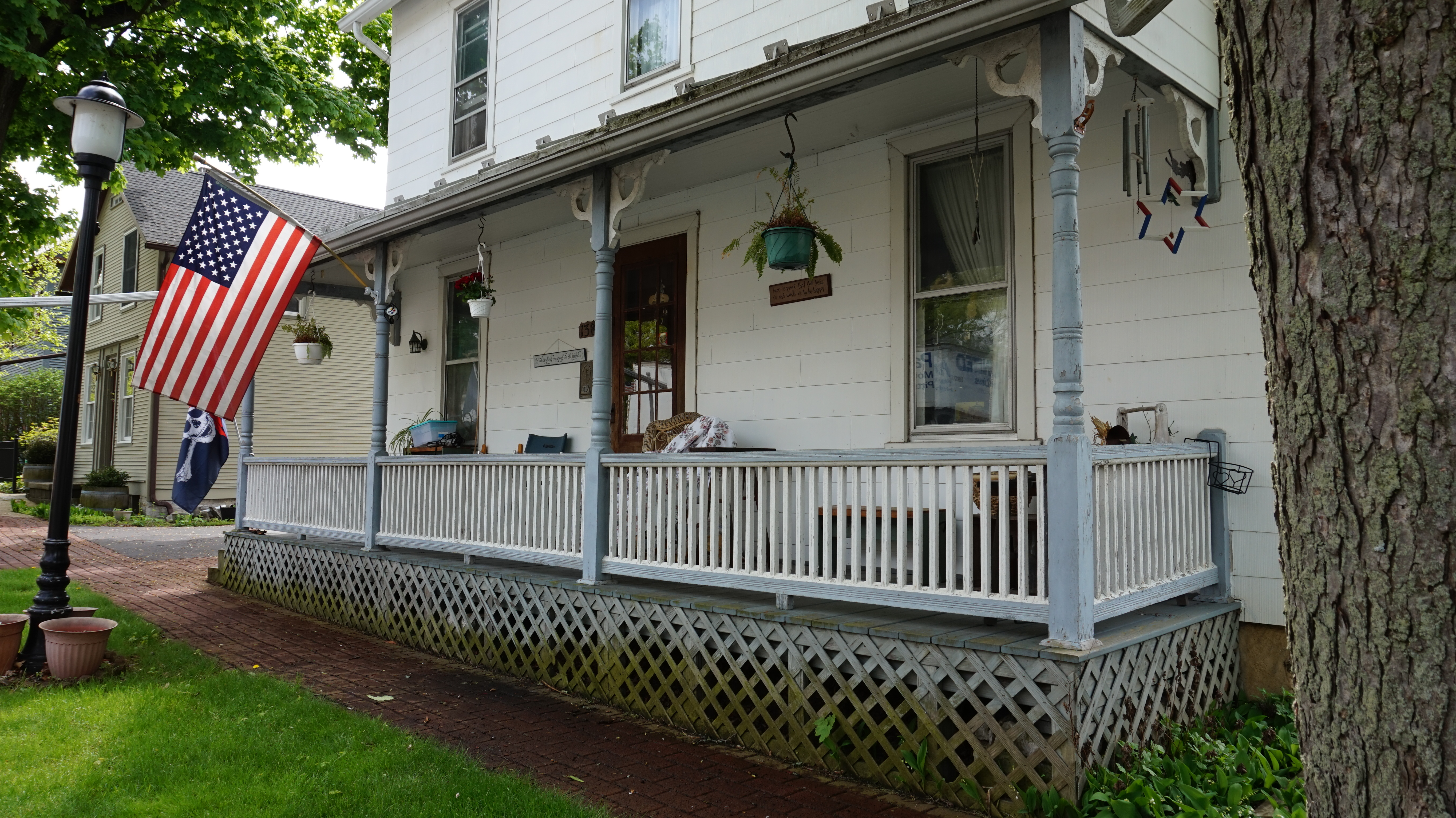
During the 19th century, this property housed an enclosure used as a livery and livestock yard for drovers staying at the Wolfe Tavern across the street. The house was built around 1900 by William Brouse, a huckster (peddler), who went door to door selling butter, eggs and chickens. The house features beautiful solid chestnut woodwork.
2.14 HM#43 Gingrich House, ca. 1800
202 W. Main Street
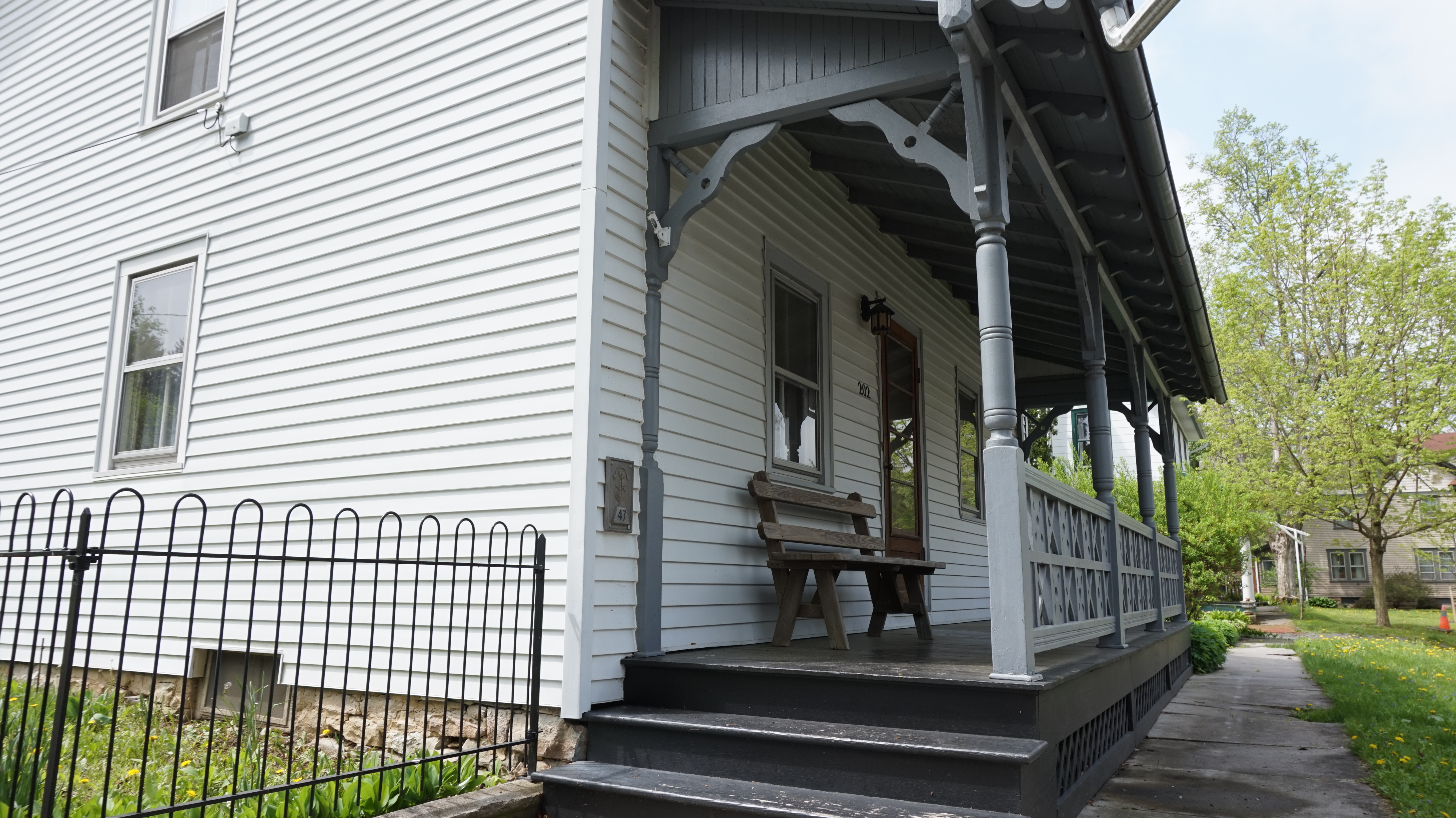
This log house sits just beyond Andrew Stroup’s 1808 plot plan for the village of Springfield (Boalsburg), and pre-dates the village. It was built around 1800 by Isaac Womer, a saddler. Mr. Womer’s saddle shop was located across the street, next to the Wolfe Tavern. His leather came from the Mosser Tannery – now the Boalsburg Heritage Museum property, (HM #62). Later in life, Mr. Womer built a new home (HM #41) and sold this one to Christ Gingrich, a farmer. Mr. Gingrich built a small shop on the property for blacksmith work, which is where his son, Albert, undoubtedly learned the skills that earned him the position as apprentice in the blacksmith shop associated with the coachworks factory on East Main St. (HM #31). Al and his brother, John, built the beautiful barn and ice house (c. 1910, HM #44) at the back of this property.
2.15 HM #44 Ice House, ca. 1910
202 W. Main Street (back of property)
Impressive craftsmanship went into engineering this ice house on the Gingrich property (HM #43). The structure was built by (brothers) John and Albert Gingrich around 1910. The building is made from solid chestnut wood. Al Gingrich, a blacksmith, made all of the iron hinges and locks. The doors are 8” thick, closing snugly with friction seals. Al and his brother would go out to a nearby pond in the winter to cut ice blocks, which they packed in the ice house, surrounding each block with sawdust for insulation and to keep the blocks separated. The structure has a cupola to vent the warmer air at the top out of the house. Ice packed in here in the winter would last all summer. Water melting from the ice was channeled into a floor drain flowed out to an attached spring-house used to keep food cool.
2.16 HM #41 Isaac Womer – Saddler, built mid-1800s
209 West Main Street

Isaac Womer, a saddler, built this vertical plank house in the mid-1800s. The foundation is about two feet wide, made with mountain stone from Tussey Mountain. The lumber for the planking was cut from the A. Myers farm (Bailey Lane); the sand for the interior plaster was carried in buckets from the Sand Springs Trail (above the present day Academy Street). Outbuildings included a stable, outhouse, chicken house, hog pen and smoke house. Isaac’s shop was located on Pitt Street (Main Street) just east of Wolf Tavern (HM#8). All of the harness Isaac made was hand-cut and hand-sewn of leather he purchased from the Mosser Tannery at the eastern end of the village (on the property of the Boalsburg Heritage Museum, HM#62). Isaac also helped out with hay-making and butchering.
2.17 HM #7 George Shenenberger – Farmer, built 1869
137 West Pine Street

George Shenenberger, a German immigrant and farmer, built this house in 1869 as a retirement home. At that time, it was the last house on Pine Street at the western edge of Andrew Stroup’s original 1808 plot plan for the village of Springfield (later Boalsburg). Beyond this house to the west was farmland. The original Shenenberger farm and homestead was on a large tract of land (300 acres purchased from Andrew Stroup in 1809) just to the north of the village of Springfield, including much of the “hillside” section of Boalsburg, the Liberty Hill development and the land now used for the Boalsburg Cemetery (which he donated).
This house was built with Italianate embellishments (popular in the 1850s to 1880s) that give it a touch of elegance. Note the Italianate lintels above the windows and the scroll saw brackets that decorate the cornice, gables and porches. The recessed side porch on the east side of the house is an unusual feature. As was typical for the period, the shutters are solid on the ground floor, but are louvered on the upper floor. This arrangement provided more privacy at the ground floor level, and helped keep out street dirt and noise. The louvered shutters on the second story provided better air circulation and a cooling breeze at night.
2.18 HM #6 Shawley
123 W. Pine

The home of Calvin and Connie Shawley is built in lot 45 of the Stroup plan.
2.19 HM #39 James Johnston – Cabinet Maker’s Shop, build date unknown
117 West Pine Street
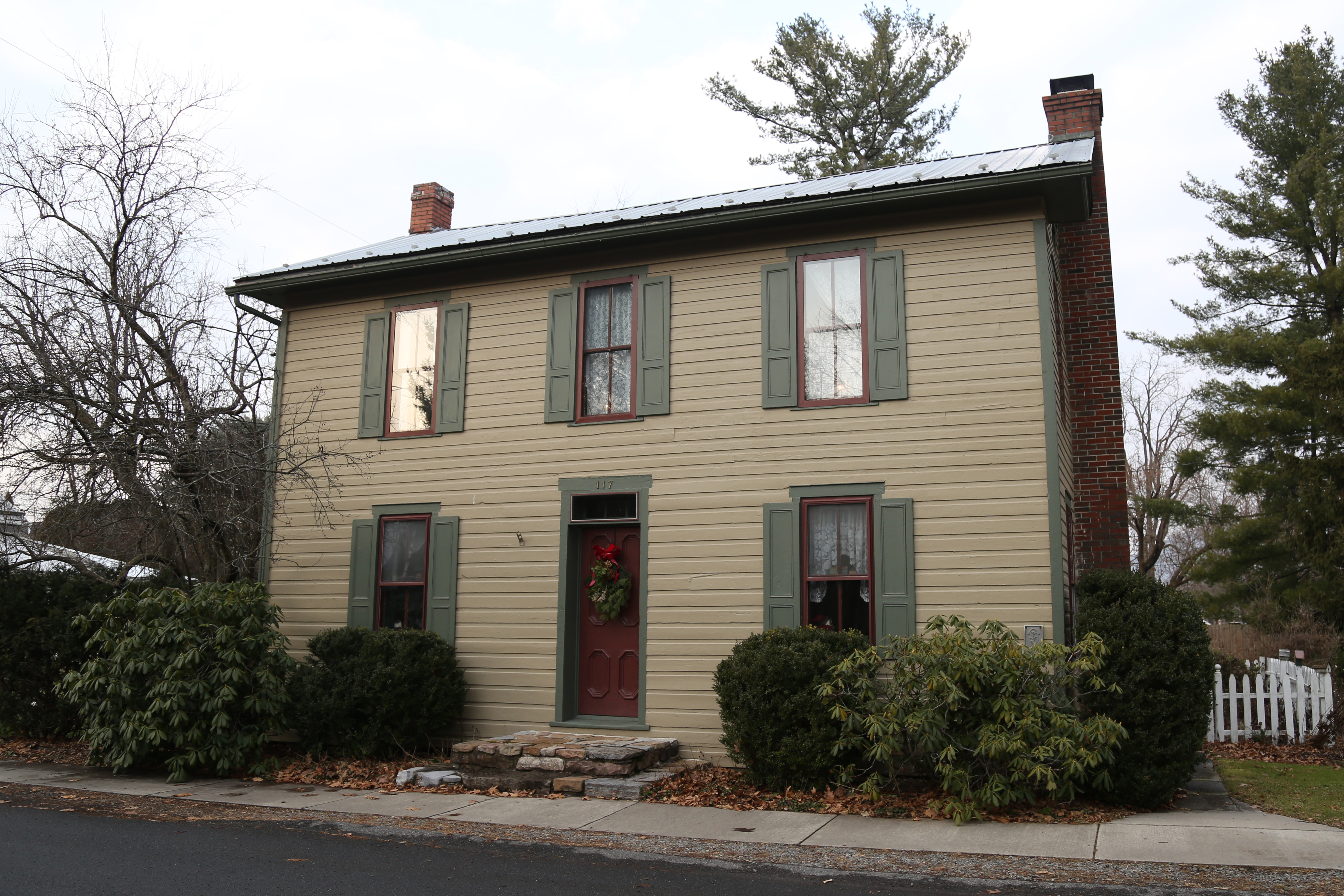
Col. Johnston* (the builder of Duffy’s Tavern) had his cabinet making shop on this property. He is thought to be the first owner of this property, but the build date of the first (log) structure is unknown (although it appears on an 1861 map of Boalsburg). James Johnston was a cabinet maker by trade, but he also owned and operated the Tavern, a local saw mill, and owned many acres of farmland. This building was constructed of hand hewn logs with wide plank floors. Other early owners of this house were David Keller and George Shenenberger (who were related – David Keller married George Shenenberger’s daughter, Margaret).
Bricks used to build the nearby German Reformed Church (now St. John’s UCC) were made of clay taken from the backyard of this and adjoining properties.
*“Col. Johnston” was actually James Johnston, Jr. (He was not a real Colonel – this moniker came from the fact that his father was a Colonel who commanded the 1st battalion from Cumberland County.) James Johnston’s name comes up time and again on deed transfers in the village. He was a wealthy businessman, owning not only the tavern, but also a saw mill and farmland in the area. He was also a cabinet maker by trade, and owned a cabinet making shop on W. Pine St (HM39). An 1823 tax record shows him owning 150 acres, a store, a tavern, and two houses, along with four lots in Boalsburg. At the time of his death in 1864, he owned over 350 acres of land.
2.20 HM #72 Brick on West Pine, Build date unknown
118 West Pine Street
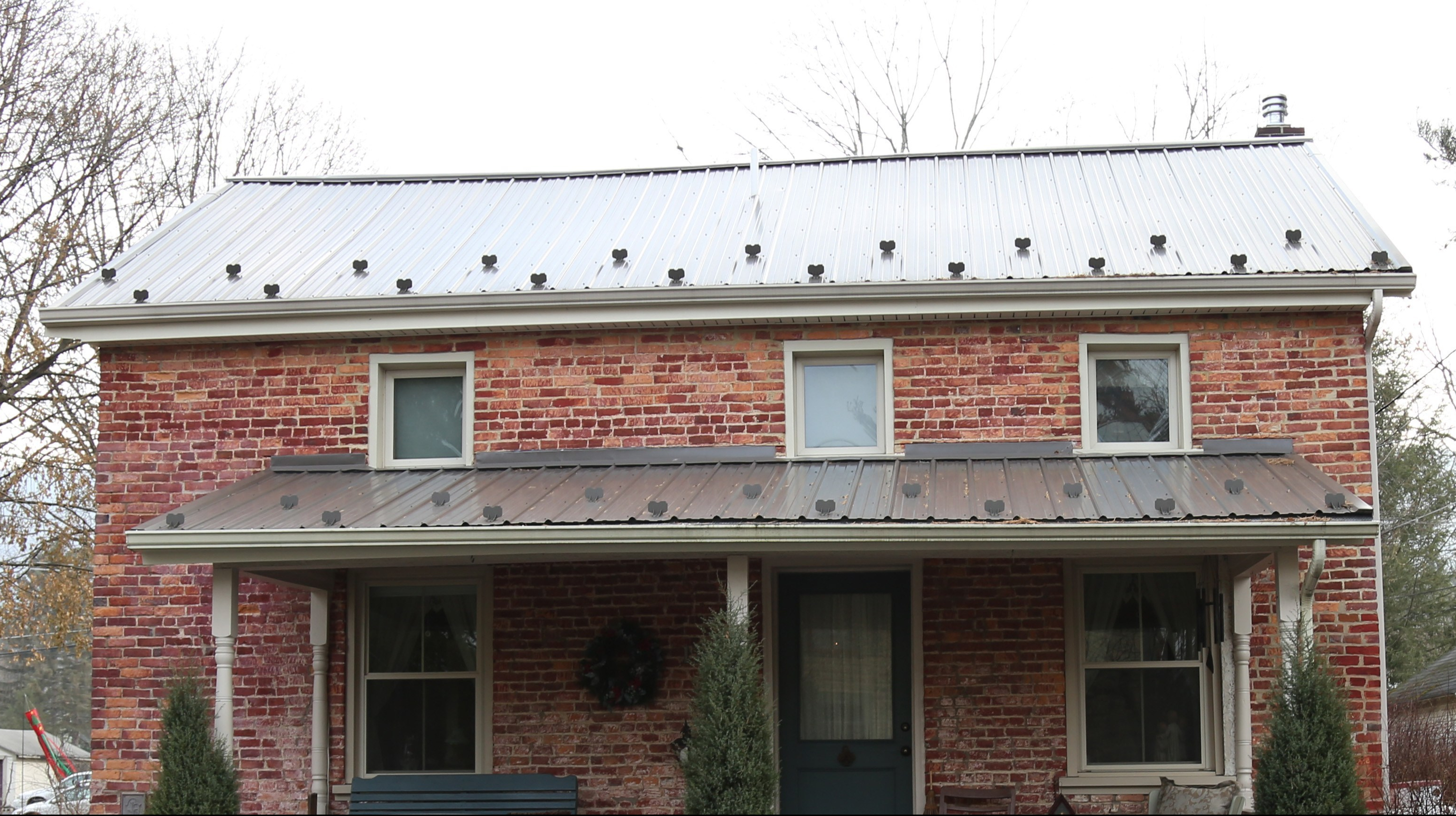
This 1 ½ story brick and stucco house is recorded in a sheriff’s sale in 1831 where High Sheriff William Ward, by order of the Court, sold the property of Jacob Dunlap to Cornelius Dale. Iron angle irons can be seen on each side of the house, which are the terminals of an iron rod stabilizer running the width of the house. Originally, there was no internal staircase; the two rooms on the upper floor were accessed by a stairway built on the outside wall at the back of the house.
2.21 HM #38 Corl House – Boalsburg Auto Bus Line, built ca. 1825
113 West Pine Street
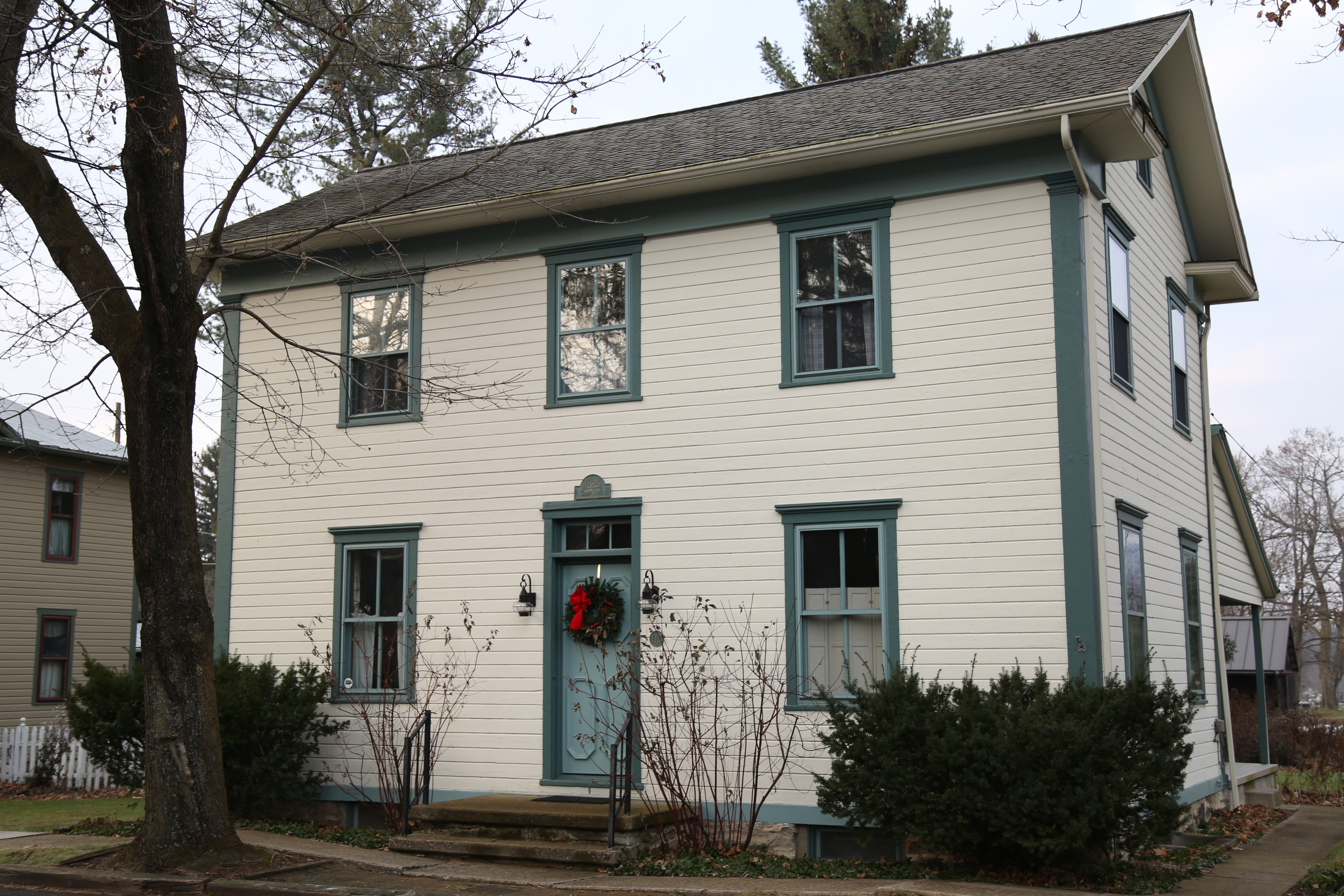
This house was constructed ca. 1825 of random width vertical planks and sided with 1-inch thick Chestnut V-grooved German lap siding. It consisted of two rooms on the first floor and four on the second floor. The original builder and early owners are unknown.
Charles and Lizzie Corl owned this house from 1899 – 1960. Charles operated a FRICK steam engine and a CASE threshing machine. Mr. Corl did threshing for the farmers of the surrounding area, and he and his steam engine were employed by the Boalsburg Water Company during the laying of new water lines and to thaw frozen lines during the winter. Later, Mr. Corl became involved in the Boalsburg Auto Bus Line, which ran between Lewistown and State College. Col. Theodore (Teddy) Boal started the bus line and employed Mr. Corl and Matthew Goheen. One of the outbuildings on the Corl property was converted into a garage to house one of the early touring cars used by the bus line company.
The Corls added a Victorian style porch that was later replaced with a small (roofless) porch built on the base of the original porch. You can still see evidence of the roof line of the original porch on the siding.
2.22 HM #5 Home of the Doctors, built (original part) between 1809-1820
123 North Church Street

The original part of this house was a log house built by James Jack between 1809 and 1820. Each corner of the original log home is braced with other logs, all hand-cut timbers, 6-10 inches thick and fastened with hand-cut nails and wooden pegs. Many of the doors are handmade, as is the heavy front door which has 35 inch iron hinges.
This house became known as “Home of the Doctors” after it was purchased by Dr. Thomas Coverly (1835), Dr. Hugh Montgomery (1841-1849), Dr. John R. Mitchell (1851-1856), Dr. Sheppard S. Vanvalzak (1865-1872), Dr. John F. Woods and his son, Dr. William Woods (1872-1934).
At one time, a small one-story addition was the town post office, served by the wife and daughter of Dr. John Woods.
2.23 HM #66 Boalsburg Fire Company Social Hall, built 1833
113 East Pine Street
The Boalsburg Volunteer Fire Company’s social room originally was a small frame structure built in 1833 at a cost of $800 by a Methodist congregation, which later disbanded. In the early 1900’s Col. Theodore (Terry) Boal bought the old church building and offered it to the town as a library / reading room / town hall. Known as Boal Hall, it was used for many village events, such as concerts, lectures, graduation exercises and dances. Not long after this, the Boalsburg Board of Education secured the use of the building for a vocational education program associated with the high school, which was next door*.
The Fire Company purchased the school property with adjoining land in 1945 and also obtained from the Boal Estate a lifetime lease on the former church building. The truck bay, kitchens, etc. were added to the original frame structure in 1949. In 1977, the Fire Company and Ladies Auxiliary raised funds for remodeling, including adding a small “museum” with a picture window facing Pine Street for displaying firefighter memorabilia and the old hose cart, which dates to 1855.
 Boalsburg Village Conservancy – 2026
 Historic Boalsburg