
Our web site is still under construction. Keep checking back for improved maps, complete walking tour directions and updated information!
Distance:
Time:
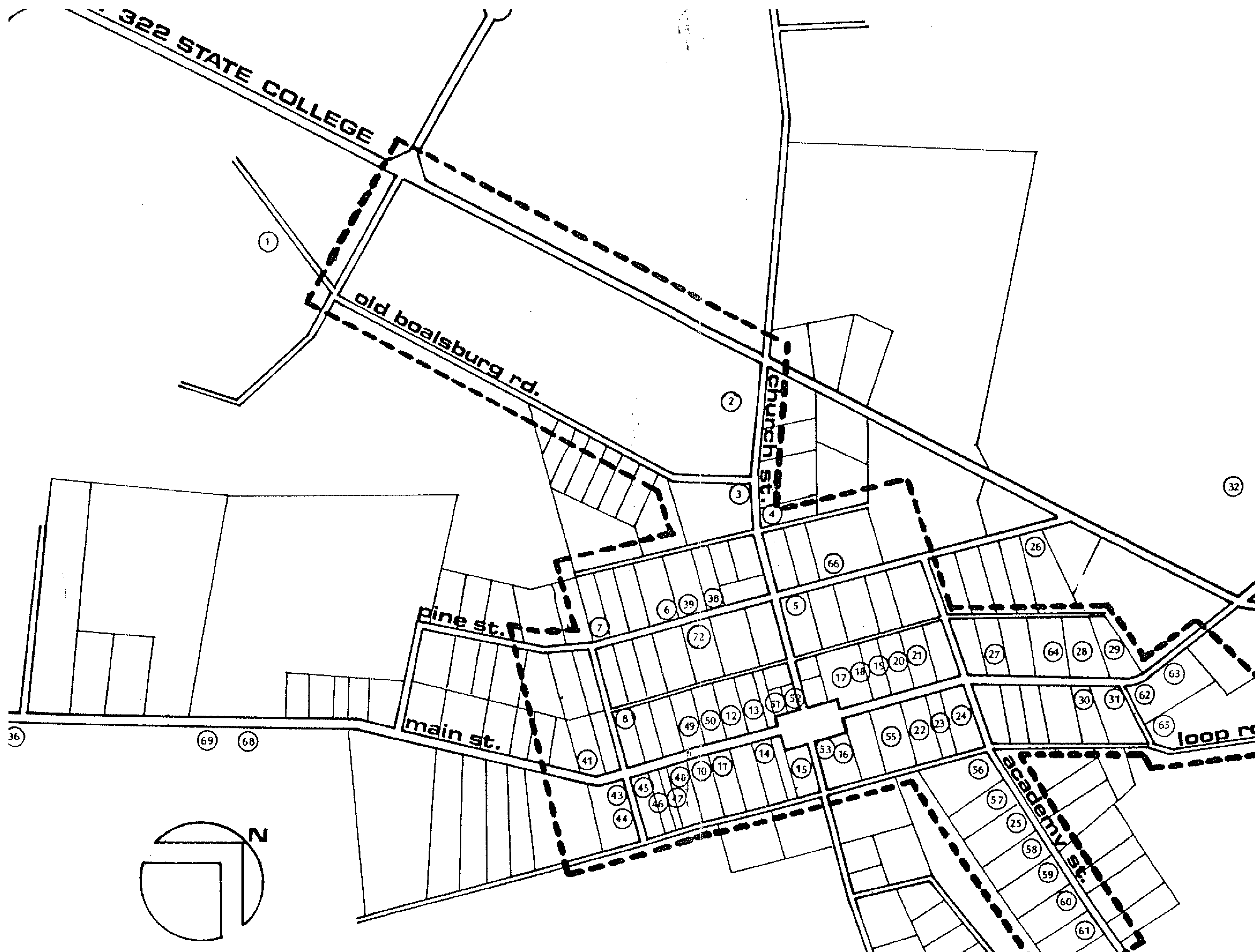
1.1 Boalsburg (Duffy’s) Tavern, built 1819 (HM#17)
113 E Main St


Completed in 1819, the Boalsburg Tavern was the jewel of the town and served as the social hub for meetings, dances, and the mail drop for the stage coach lines. It was owned and operated by Col. James Johnston* and his wife, Hanna Bethesda. Their initials and the build date are carved into a stone on the front of the building, between two upper window shutters. The tavern is a 2 ½ story Georgian center hall building, originally just the 5 bays on the west side. Notice the fine details that make the building truly a centerpiece for the town, such as the fine masonry work and the keystones over the windows bordered by red sandstone. The masonry work on the addition (2 bays on the east side) was also very skillfully done, and the original corner stones were reused to make the new corners. The addition originally had a solid dividing wall between it and the tavern – no connecting doorways inside to the tavern – and is thought to have been an apartment for the innkeeper and his family, possibly when James’s son, George, was the innkeeper. The eastern wall of the addition is not finished with the same fine stonework as the front of the tavern – it’s of rubble construction – probably because it had a coach port with a roof attached to it for the coaches to pull into and disembark passengers. (Source: Cathy Horner’s book, “The History of the Boalsburg Tavern – and the Woman Who Saved It.”) Note also, the conventional figuration of solid shutters downstairs, louvered upstairs. The front door is the original, with the original box lock.
The Boalsburg Tavern served as a stage coach stop for two major routes – one which ran from the Susquehanna River (near Lewisburg) to Spruce Creek, approximately following route 45 (or one could connect to another line in Pine Grove Mills to go over the mountains and all the way to Pittsburgh); The other major line made the tortuous journey over the Seven Mountains from Lewistown, following what is now route 322. The coach driver would give a number of horn blasts as they pulled into town – the number of blasts corresponding to the number of passengers on board – so that the tavern operator could begin preparing for the arrival of the guests. We get the term “tip” from stagecoaching days: it comes from an acronym, TIP, which stood for “to insure promptness”. Passengers would tip the driver to encourage him to be prompt with the unloading of the luggage. (Source: Cathy Horner’s book, “The History of the Boalsburg Tavern – and the Woman Who Saved It.”)
Once this tavern was built, it catered to a higher class of clientele than the Boal Tavern at the eastern edge of town. The meals served here would have been fancier than the meals at the Boal Tavern, and you slept upstairs on actual beds. However, we’re told that travelers slept fully clothed, lying side by side with fellow travelers on the same bed! Men and women slept in one large room upstairs with a dividing wall between the women’s and men’s side.
This tavern has had many owners over the years. James Johnston sold the tavern in 1865 to Sam Stover, who ran a dry establishment. (The temperance movement had begun then, a reaction to a recognition that excessive drinking was leading to all kinds of ills – from disease to workplace accidents to bar fights. Prior to the mid-1800s, alcohol was consumed at every meal in some form or other, and ale was often given to workmen as part of their daily wages.) The next owners, James and Emma Stuart (nee Emma Hunter), also ran a dry establishment. (The Stuart home was across the street, HM#53.)
Col. Theodore (Terry) Boal purchased the tavern in 1905, as a rental concern – he rented it out to various innkeepers. A devastating fire gutted the building in 1934. The depression hit Boalsburg residents very hard, including the Boal family. Terry Boal was in debt to the bank by then, so the ruined tavern ended up being a property of the bank and lay fallow and exposed to the elements for three years. In 1937, Roanna (Billy) Windsor purchased it from the bank for $500. She was a graduate of the Pennsylvania State College (now Penn State University) who happened to be back visiting the area when she heard what had happened to the tavern and decided she had to buy it and restore it – which she did with great attention to detail, salvaging everything that could be reused and trying as much as possible to restore the building to its original condition. Ms. Windsor reopened the tavern in 1938, but then WWII broke out, and she went off to serve in the Navy Waves, so the tavern was closed for a few years until she sold it to Mary and Harry Duffy in 1946. They renamed it Duffy’s Tavern, and the name has stuck. (Source: Cathy Horner’s book, “The History of the Boalsburg Tavern – and the Woman Who Saved It.”)
[Carl and Joanne Hacker ran Duffy’s Tavern from 1971 – 2012. Current owners (since 2012) are Darren and Tracy Moriarty.]
To the west side of the building you can still see the old town pump and water trough where the stage coach driver, farmers and other visitors to town would have watered their horses.
*“Col. Johnston” was actually James Johnston, Jr. (He was not a real Colonel – this moniker came from the fact that his father was a Colonel who commanded the 1st battalion from Cumberland County.) James Johnston’s name comes up time and again on deed transfers in the village. He was a wealthy businessman, owning not only the tavern, but also a saw mill and farmland in the area. He was also a cabinet maker by trade, and owned a cabinet making shop on W. Pine St (HM#39). An 1823 tax record shows him owning 150 acres, a store, a tavern, two houses, along with four lots in Boalsburg. At the time of his death in 1864, he owned over 350 acres of land.
1.2 Little Brick, ca. 1835-1839 – HM#18
117 E. Main Street
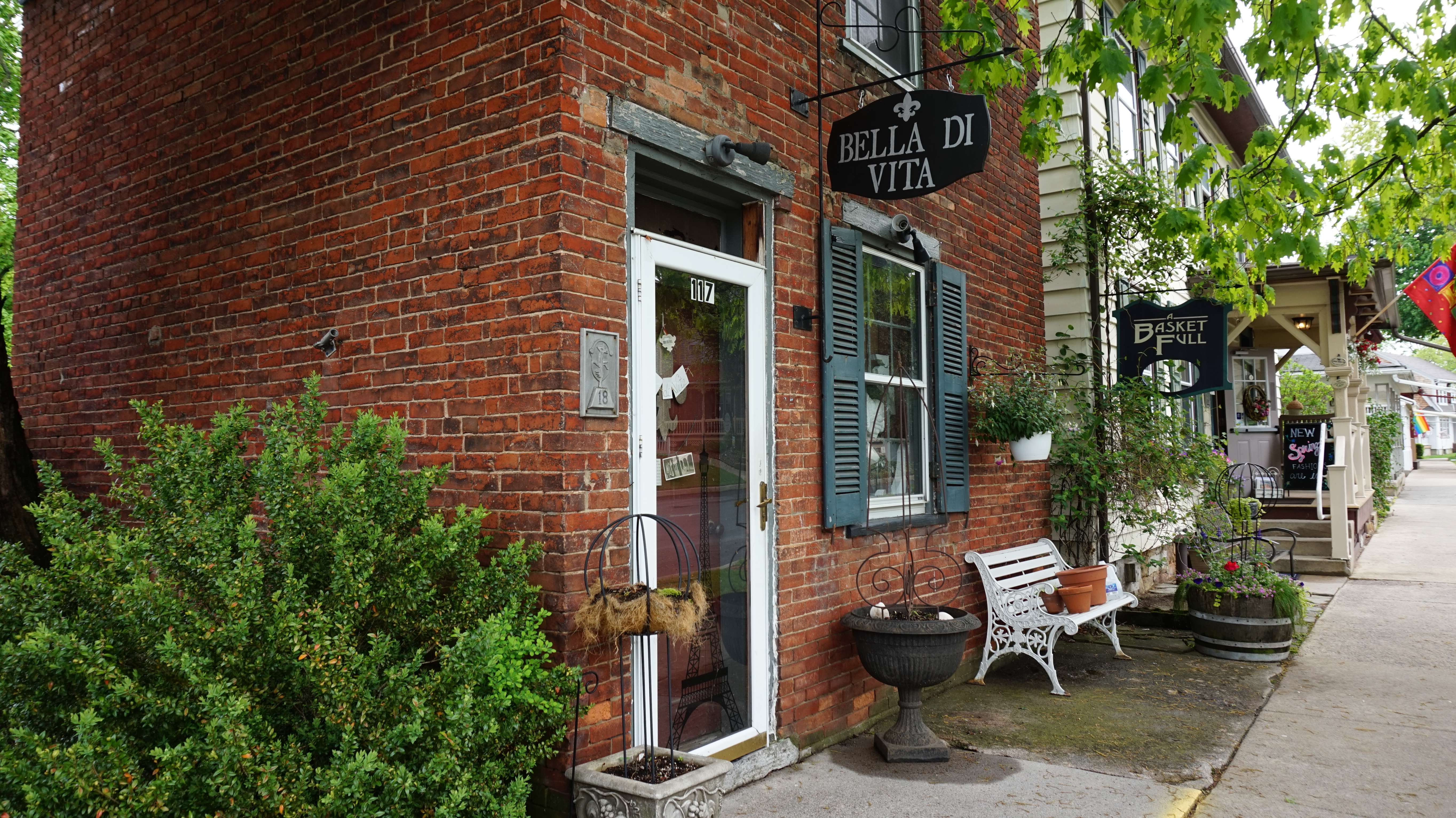
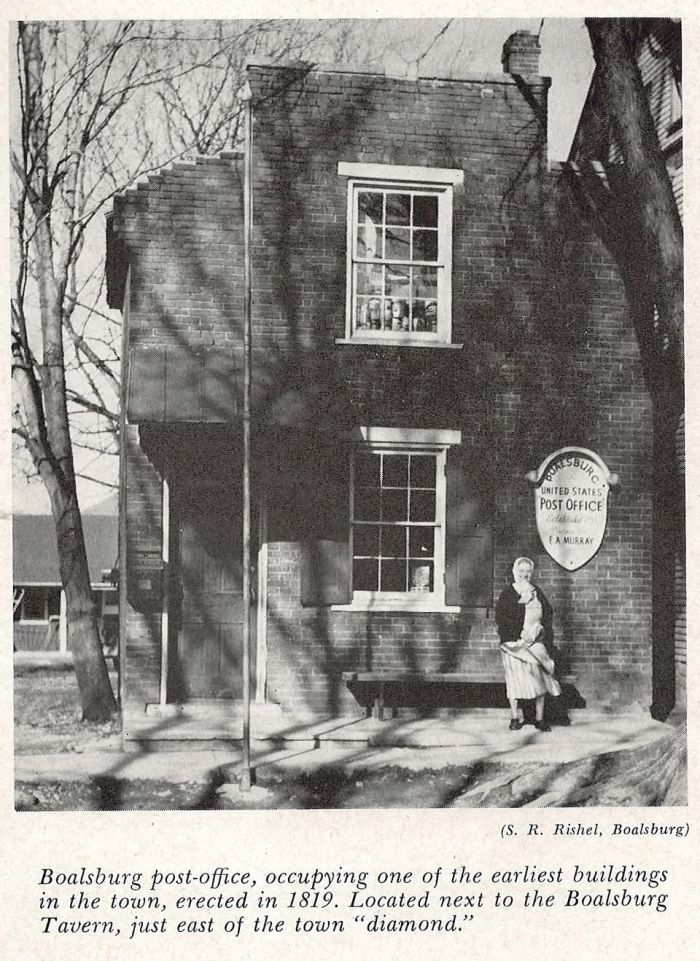
This structure is part of the Duffy’s Tavern property, and has been rented out to many tenants over the years. Built ca. 1835-1839, the thick brick walls and lack of “piercings” suggest that it may have originally been built to serve as an armory for a peacetime militia (as communicated to Paula Ralph by Carl Hacker). With little natural light and no internal staircase, it would not have been ideal for either a shop or dwelling, although it has been used as both. Originally, the second story could only be reached by a wooden staircase attached at the back on the outside. An internal staircase was added in the 1970s.
It has been used for all kinds of businesses, including by a furniture maker, an undertaker, and a shoemaker. This building also served as the town post office starting in 1935. Gussie Murray was the postmistress, a post she held for some 25 years. Her home was on S. Academy Street (HM#58).
1.3 Two Doors House, build date unknown – HM#19
121 East Main Street

John Irvin purchased this house around 1824 in a sheriff’s sale. Prior to that, it had been owned by John M. Beuck, a cabinetmaker, but we don’t know whether John Beuck built the house. Since then, tax records show that this house had many subsequent owners for the next 100 years. These various owners were listed as having a wide variety of trades – a retired collier, a weaver and postmaster, a chair maker, a farmer, and a doctor – reflecting the self-sufficient nature of Early American village life.
The front porch of this house features heavy ornamental decorations that were typical after the 1860s, suggesting that the porch may have been a later addition. It is not known why there are two front entrances, although often a house in the 1800s with two front doors would indicate that one door led directly into a formal front parlor, or “Sunday parlor”, a room for receiving guests without having them enter the “every day” part of the house. In other cases, having two front doors was an aesthetic choice for pleasing symmetry (and doors were less expensive than windows), or it could indicate that there was a room or apartment that was rented out.
1.4 Jacob Ferrer – Grain Cradle Maker, build date unknown – HM#20
129 East Main Street

In the mid-1800’s, this was the shop of Jacob Ferrer, who made a farm tool called a grain cradle, a type of scythe with wooden spokes attached to catch the grain once it was cut. We’re told that Mr. Ferrer always painted the handles of his grain cradles red. His shop was a one story building, the ground floor, front section of this home.
1.5 Dunlap / Karn House, Built 1812-1819 – HM#21
133 E. Main Street


This log house was built sometime between 1812 and 1819 by Daniel Dunlap, a carpenter by trade. Not much is known about the next owner, John Irvin, but we know quite a bit about the 3rd owner, John Karn (wife, Mary), who purchased the house in 1829. Mr. Karn died just two years later. Because he died without a will, his estate was put into probate, and everything in the house was sold at a public auction. A detailed list of everything that was in the house at the time, right down to the pattern of their best porcelain, is on record in the estate papers in the Centre County Historical Society Library in Bellefonte. His wife received $100 from the estate. (Women could not own property at that time.) Among his possessions were bills of sale to “John Karn, gunsmith” and gun smithing tools and gun parts, so we can infer that John Karn was a gunsmith by trade. (As communicated to Paula Ralph by David Brassington.)
From Sally McMurray student paper (Hadley Goad, 1998):
The window and door placements are that of mid-Atlantic Georgian-style farmhouse. The window frames are hand cut and may represent a simplified Georgian style. The moldings on the front side corners and front door are a simplified Neoclassical Greek Revival. Stenciled walls were uncovered during a 1973 renovation. Stenciling was popular in the first quarter of the 19th century.
The front porch is NOT original to the house, though there is evidence to suggest that it was added much earlier than the other porches in the village. All of the moldings are hand-hewn. It is Gothic Revival in styling, a style popular in the 1830s and 1840s.
In 1995, the tin roof and underlying shaker shingle roof were removed and a modern roof installed. At this time, a heightened third-floor wall was installed in the back of the house, creating a taller roof-line, turning what was sloped-roof attic space into additional living space on the 3rd floor. A bay window was also added.
From 1905 to 1963, this house was owned by various members of the Dale/Ricker family.
1.6 HM#27 – Sears “Verona” House, 1925
203 E. Main Street
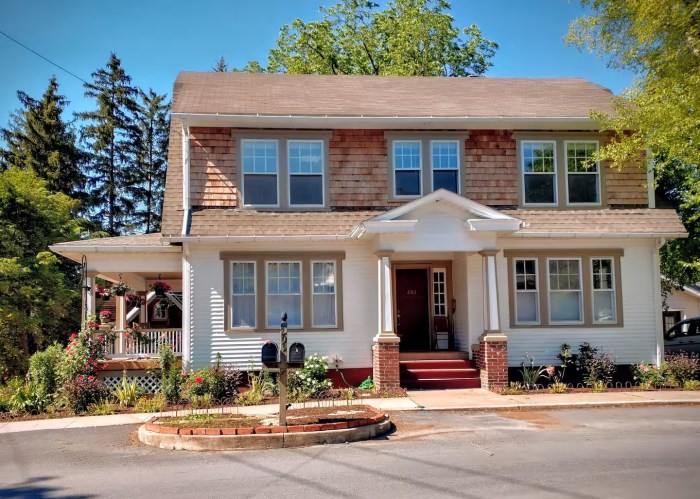
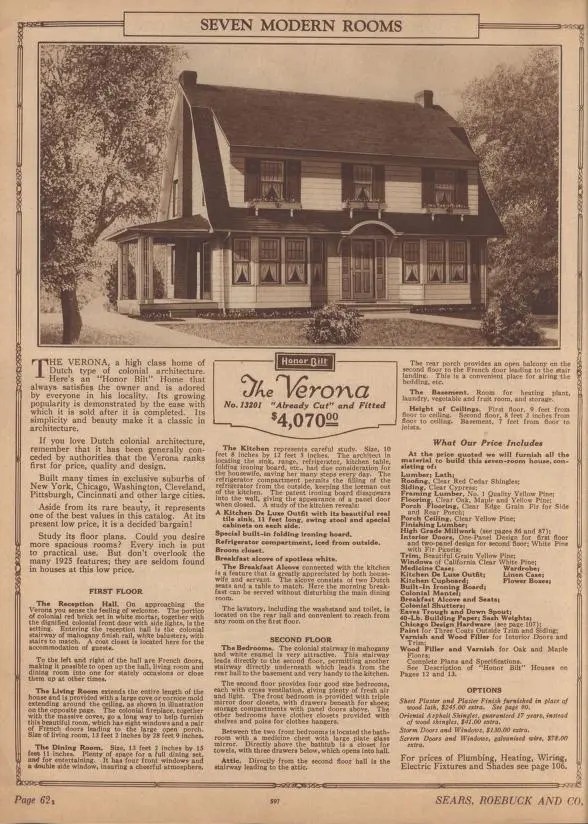
This property was listed as Lot #4 on the original “Springfield” village site plan by Andrew Stroup and it was originally owned by George and Elizabeth Boal. They sold the property to Peter Fisher in 1857. After the property changed hands several times, it was purchased by John and Helen Ishler in 1921. The house itself was built by Ishler in 1925 and became his family residence with his butcher shop and slaughterhouse business at the rear of the property along Rockeys Alley. Speculation has it that the house was ordered from a Sears and Roebuck catalogue and called “The Verona”. It’s of Dutch colonial architecture.
The Ishlers lost the property and business as a result of the Great Depression of 1932. The house and property was then purchased by Dr. Peter and Emma Swank. Dr. Swank converted the single family home into his medical practice on the first floor and his family’s residence on the second floor. Dr. Swank passed away in 1950 and the property went to his son Howard who opened both floors as apartments.
In 1995, after the death of Howard Swank, Ken Hull purchased the property from Howard’s son Richard and lived in one of the apartments for several years. The house is still owned by Ken along with his wife Claire Lorts who both reside in the log cabin behind. The log cabin was constructed in 2000. It was built as an art gallery and studio for Ken after he outgrew his space in the “Little Brick” HM #18. As an artist, Ken wanted to build something that “fit the history, feel, and aesthetic” of the Village. The logs came from a Huntingdon County sawmill and had already been cut flat on both sides. Once on-site, the logs were set in place and the corner notches were cut by hand in a chamfer-and-notch style indicative of early German building techniques. This type of corner notching allowed the four walls to go up without the need for nails or screws as the corners actually drew tighter as they setted.
1.7 HM#27 – 2 Red Brick Houses, build dates 1830 & 1835
209/211 E. Main Street

This looks like one long brick house with two front porches, but actually, it is two separate houses built five years apart in the 1830’s. The house on the left was built in 1835 by Jonathan Shaeffer, a tailor; the house on the right was built in 1830 by Daniel Kimport. At some later date someone filled in the passageway between the houses, creating a storage space. Local village lore says that when the Civil War broke out, the village used this storeroom as an “arsenal”, hiding their guns and ammunition under lock and key in case the town should be overrun by Confederate soldiers. They didn’t want their guns and ammunition falling into the hands of the enemy, as occurred elsewhere in Pennsylvania, such as Chambersburg.
1.8 hm#64 – Coachmaker’s House, ca. 1846
223/225 E. Main Street

For many years, this property was owned by the coachworks factory across the street (HM #30) to house the coachmaker’s family. Built by the first coachmaker, James Logue, it was further expanded by a later coachmaker, J. M. Weiland, who had a very large family (including nine children and his mother-in-law).
1.9 HM #28 Joseph Meyer (Organist’s House), ca. 1868
229 East Main Street
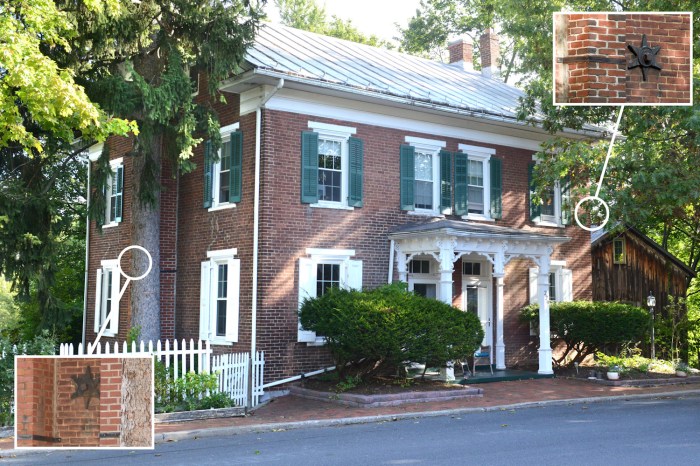
Mr. Joseph Meyer, the organist at St John’s Church, began construction on this brick house in 1868. Sadly he died while playing the organ the night before the new, now historic, Durner pipe organ was to be dedicated. His family, Henry and Jacob Meyer, finished the construction and his widow lived in the house for many years. The property belonged to Austin Dale and his daughter Catherine, from 1911 into the 1950s. It was then owned by the Spalvin family until the end of the twentieth century.
The iron “stars,” visible at the second floor level of each end, are terminals of an iron rod “stabilizer” running the width of the house. The house has no fireplaces because stoves had become fashionable for heating in the 1860’s. The original plaster covers the walls next to the exterior brick. You will notice that there are wooden shutters on the first floor, but louvered shutters on the second floor. This was a standard configuration at the time – the solid shutters on the ground floor kept street dirt and noise out, and provided some privacy for the family; the louvered shutters on the upper floors allowed for a cooling breeze at night. A typical Pennsylvania German feature of this brick house is that there are two doors on the front porch, a Sunday entrance on the left, reserved for special gatherings and events, in addition to an everyday entrance on the right.
1.10 hm #29 David Boal Tavern, built 1804
229 East Main Street (east side of property)

“The growth of any place is propelled partly by the transportation to and from it,” wrote Robert Emmers, a journalist and Boalsburg native. The town of Springfield, later named Boalsburg was proof. The town prospered from those who stopped at its taverns for refreshments and respite. The first of these taverns was built in 1804 by Irish immigrant David Boal (1764 -1837), on land purchased from Andrew Stroup. It was located along Pitt Road, now Main Street. Traveling from Lewistown and Lewisburg, weary travelers coming by wagons, carriages and stagecoaches along with drovers, could rest by the Tavern’s open hearth fireplace while drinking a jug of ale before climbing up the winding steps to the top floor to sleep on straw mats. Horses were housed in the wooden building in the back of the Tavern. The original outhouse is now a chicken coop. The Tavern retains its original horsehair plaster, fireplace, cooking instruments, and stone facade.
A later owner added a two-story wooden addition to the front of the stone tavern building, which was used to operate a general store, starting in around 1827. That two-story addition was later sold and relocated (in 1870), after the general store was no longer in operation. Pulleys were used to hoist the wooden structure onto logs, and a team of horses was used to roll the building to its new location on Church Street, where it now sits. It is the main part of the house at 217 North Church Street (HM#4).
1.11 HM #63 Boalsburg Electric Company (AKA “the lighthouse”), build date unknown
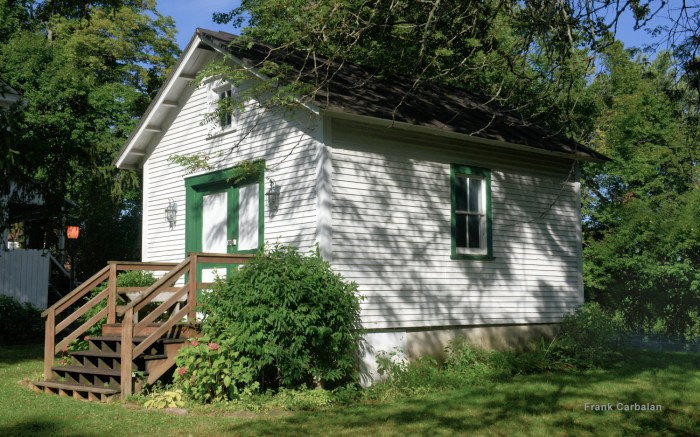
The “Light House” is the name given to the building that supplied electric light to the streets and houses of Boalsburg from 1914 to 1930. Most of the same men who had started the Boalsburg Water Company a few years earlier – T.D. Boal, H.C. Rothrock, W.H. Stuart, William Myers, and Dr. L.E. Kidder – believed that water from Galbraith Gap in Bear Meadow, could be used to generate electricity. They signed an agreement with Harris Township to supply lights to the streets for $175 per annum for a period of three years. Light was to be supplied starting a half hour before sunset on clear days and one hour before sunset on cloudy days, and continued until sunrise on clear days and a half hour after sunrise on cloudy days.
A pipeline was laid and the “Light House” was built on land donated by William Myers. Water turned a turbine in the basement, and belts coming through openings in the floor turned the generator. Lines were strung from telephone poles at first, but later electric poles were strung.
Eventually there was a demand for electricity in the homes and it was provided first on Mondays to accommodate washing, and later also on Tuesday for ironing, at a charge of twenty-five cents per month for individual use of each iron and washer. Apparently, homeowners could have electricity run into their homes on a trial basis because there is record of Mr. Austin Dale who lived at 229 West Main Street, having light in his home for ten days and if he was not satisfied it would be removed at no cost. Meters began to be used in 1921, but those without meters were to be charged a minimum of $1 per month.
Finally on January 30, 1930, the Boalsburg Electric Company was sold to West Penn Power Company for $19,750. The Light House building became part of a dwelling on Loop Road, but in 2000, through efforts by the Sweet Family and Harris Township, it was returned to its original location.
1.12 HM #62 The Boalsburg Heritage Museum, built 1825
304 East Main Street

In 1825, William Murray built the house that is now the Boalsburg Heritage Museum on a parcel of land at the east end of town. This plank house is an exemplary example of early Pennsylvania architecture: hand hewn boards were hung vertically from a frame, with horizontal siding on the outside and horizontal lathe and plaster on the inside, creating three layers. Electricity to light Boalsburg’s first street was produced in the property’s “lighthouse” during this time. Additional farm buildings included a summer kitchen with a beehive oven and smoke house, and a bank barn. After her father’s death in 1932, Sarah Myers-Sweet lived in the home for 51 years and was known lovingly by the town children as Grandma Sweet.
In 1983, the house and outbuildings became the property of the Boalsburg Heritage Museum Association. The museum captures the history of the village and offers it to visitors through exhibits, artifacts, publications, events, and presentations.
For visiting times and exhibit information check the website Boalsburg Heritage Museum.
1.13 HM #65 The Tanner’s House, built 1802
320 Loop Road

The Tanners House is thought to be the second oldest residence in the village. It was originally a small log house built in 1802. Siding was not added to the house until the early twentieth century. The house is called the Tanners House because in 1837, Daniel and Jonathan Mosser began the tannery enterprise in this area at the east end of Boalsburg, which was considered outside of town at the time. There are no records that indicate that either of them actually lived in this house. The Boalsburg Tannery relied on water from the nearby Spring Creek, and it operated through the 1880s. The Tannery business is long gone, but the house remains on the property which now belongs to the Boalsburg Heritage Museum.
A tanner makes leather from animal hides. A steady supply of fir bark is needed in a tannery operation, since tannins in the bark are needed to turn animal hides into leather. Our Boalsburg tanner would have owned property on the mountainside to supply the fir bark he needed. Nearby saddlers and shoemakers would have gotten their leather from this tannery operation.
1.14– School House
1.15 HM #31 Blacksmith Shop, build date unknown
224 E. Main Street


Albert Gingrich (1881 – 1958), the last blacksmith and coach maker in his shop.
Willard Schilling

The blacksmith shop sits on the east side of what is now the Harris Township Municipal Office building, and was associated with a coachworks factory (HM30) which opened ca. 1846. However, a blacksmith shop on this site may have pre-dated the factory. Once the coachworks factory was built, this shop would have been dedicated to making the wheel rims (tires) and other iron parts for coaches, buggies and wagons. With its original Swedish anvil, working forge and original set of tools, it is one of the best preserved examples of an early American blacksmith shop in the country.
More information on The Blacksmith shop.
1.16 HM #30 Coachworks factory, ca. 1846
224 E. Main Street


Huntington Bus built by Boalsburg Coach Works outside of the Coach Works building. Prior to 1899 when third floor was added.
Blacksmith and Coach Works Shops Date unknown but after 1899.

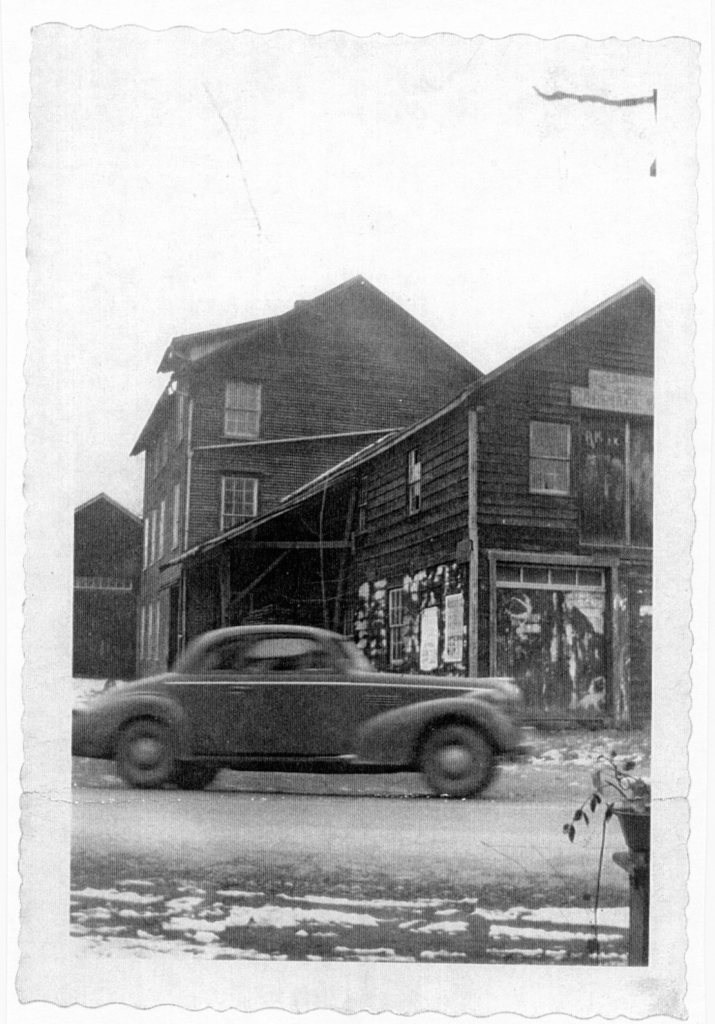
Coach works shop circa 1930-1940
Currently housing the Harris Township Municipal Offices, this building was once a large coachworks factory which opened ca. 1846. James Logue, an Irishman, was the first coach maker. The coach maker’s house was located across the street (HM #64). An 1850 census lists three other people employed at the coachworks – a second coach maker, an apprentice coach maker, and a blacksmith. By 1860, there were eight employees, including Mr. Logue’s son (also a coach maker), a blacksmith apprentice, and some general laborers. A fire destroyed half of the factory in 1899, but the owner at the time, John Weiland, rebuilt the factory, bigger and better, adding a third story, steam power and a pulley-operated elevator that could lift the coaches up to the upper floors. The woodworking equipment was located on the ground floor, and because of the saw dust that created, the coaches were brought up on the elevator to the second floor for paint work. There was a balcony on the second floor where the coaches could be set out in the sun while the paint dried. The third store housed industrial sewing machines for stitching leatherwork, surrey tops and upholstery. In addition to coaches, the factory made buggies and wagons. The milk wagon on display at Meyer Dairy was made in this factory. Boalsburg’s last blacksmith and coach maker was Albert Gingrich who began his career as a blacksmith’s apprentice at age 14 in 1895 and became the sole owner of the factory by 1924. His home is located on West Main St. (HM #43).
*The second coachmaker was W. A. Murray (1866-1899) who had a home on Academy Street (HM#58). The third coachmaker was J.M. Wieland (1899) who took on Albert Gingrich, blacksmith, as a business partner. By 1924, Al Gingrich was the sole owner.
1.17 HM # 56 The Parsonage
122 Academy Street
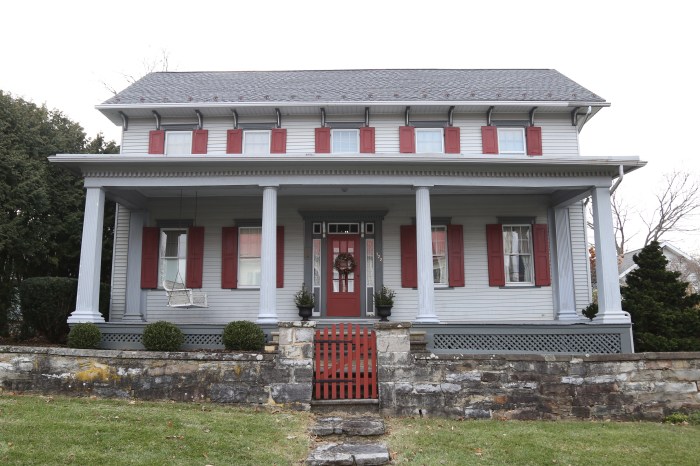
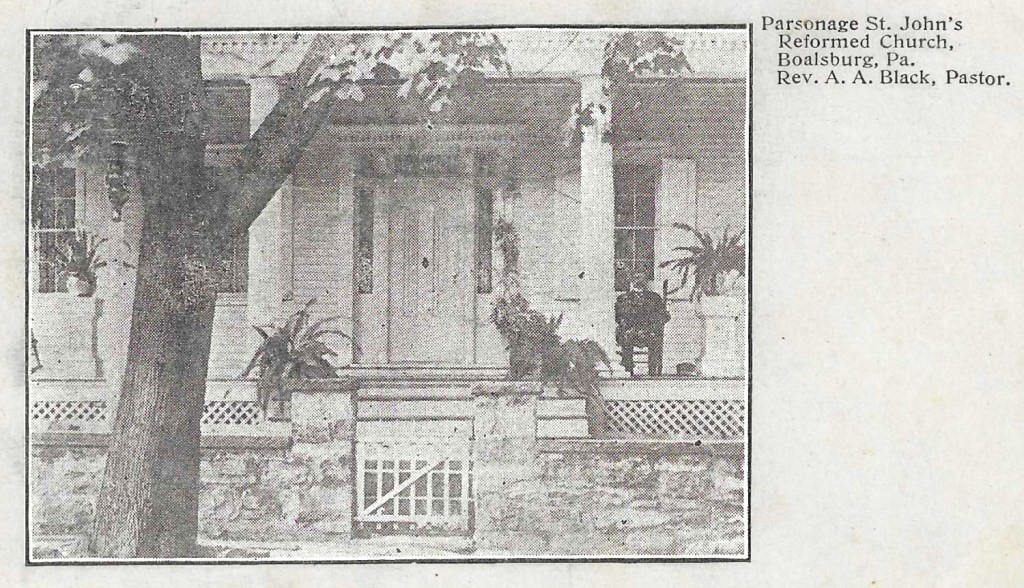

The Academy Street house known to old Boalsburg as The Parsonage was completed in 1860 on an acre lot bought from Daniel Kimport by the Trustees of the Joint Consistory for the five congregations then forming the Boalsburg Charge of the United Church of Christ.
The house and a stable, pigsty, and privy were ready within ten months at a cost of $1,720.00. Pastor William H. Groh and his family were the first to occupy the beautiful, well built large house with a garden, orchard, and grapes to tend as well. Their successors felt the burden increasingly, maintenance and repairs weren’t always adequate, and in 1952 the Joint Consistory of the remaining congregation sold the property for $12,000.00 to Mr. and Mrs. Niles Keesler. The Keeslers made extensive renovations in their six years of ownership to the Parsonage’s early eminence among village homes. This partly accounts for the $18,000.00 paid by the Consistory to repurchase it when a small Panorama Village personage proved unsatisfactory and construction of a suitable new house would have been prohibitive.
1.18 HM # 25 Boalsburg Academy
130 Academy Street

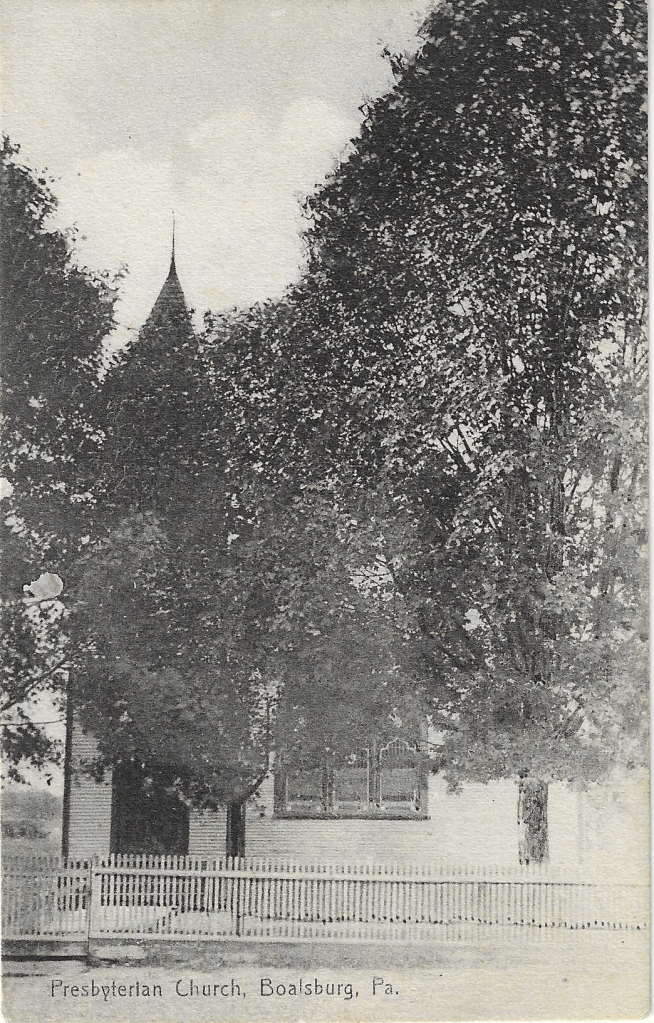
The idea for an academy in Boalsburg was originated by pastor Peter Fisher of St. John’s Church, Hon. George Boal, Henry Keller, and George Jack. Money was raised by stock subscriptions of twenty-five dollar shares, and a two-story frame building was erected in 1853. The upper room was designated for the use as a school, the lower floor was a place of worship. The first instructor remained for several years while enrolling from seventy-five to eighty students. But the prosperity of the school was seriously interrupted during the Civil War, as teacher and students enlisted and entered the army. It is reported that about seventy percent of the students entered the army. After the war, under the principalship of Mr. George Lesher, the academy gained its former standing. When the Boalsburg Academy closed in 1893, the building was purchased by the Presbyterian Church. The original building was razed and a new church was built by the congregation on the same site. Presently the Harris Township Lions Club utilizes the building.
1.19 hm # 57 “Old Jimmie” Logue
204 Academy Street

Once owned by “Old Jimmie” Logue who operated Boalsburg’s first carriage factory (house mark 30) on Pitt (Main) Street, this property was bought by the “Major” Harry Miller. His daughter, Nora, inherited it and lived there with Mary Reish, her half-sister.
Mary Reish was a fine dressmaker and went out by day, week or longer to sew for a family. Nora Miller also was a fine seamstress and did sewing for Mrs. Theodore Boal. Nora had a loom in her home and wove rugs. When her health failed, she gave the property to a Nursing Home in Allenwood in return for her care.
1.20 hm #58 Murray
212 Academy Street
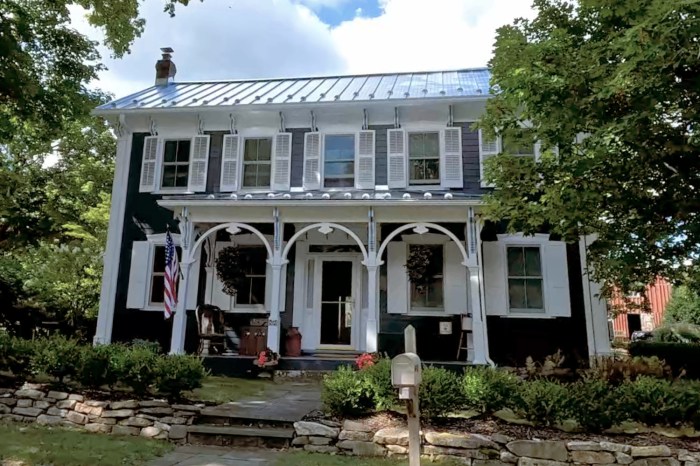
About 1863 this residence was built for William A. Murray — a descendant of early settlers Levi Murray, a tanner, and his son, George, a wagon maker. William A. Murray, a surveyor and civic-minded man, was on the school board and actively involved in the welfare of the Presbyterian Church. In 1878 he was elected a Representative in the Pennsylvania Legislature where he served two terms. W.A. Murray was also the second owner of the coachworks on Pitt Street (East Main Street).
This house built in the least two stages is constructed from hand-hewn beams pegged together. The home remained in one family for 107 Years. Mr. Murray and his three daughters living out their lives in it. Miss Augusta Murray (the last survivor) was Postmistress of Boalsburg for many years. After her death in 1970 the property was sold at an auction.
1.21 HM #24 John Hess – Hat Maker, built starting ca. 1826 (completion date unknown)
138 E. Main Street
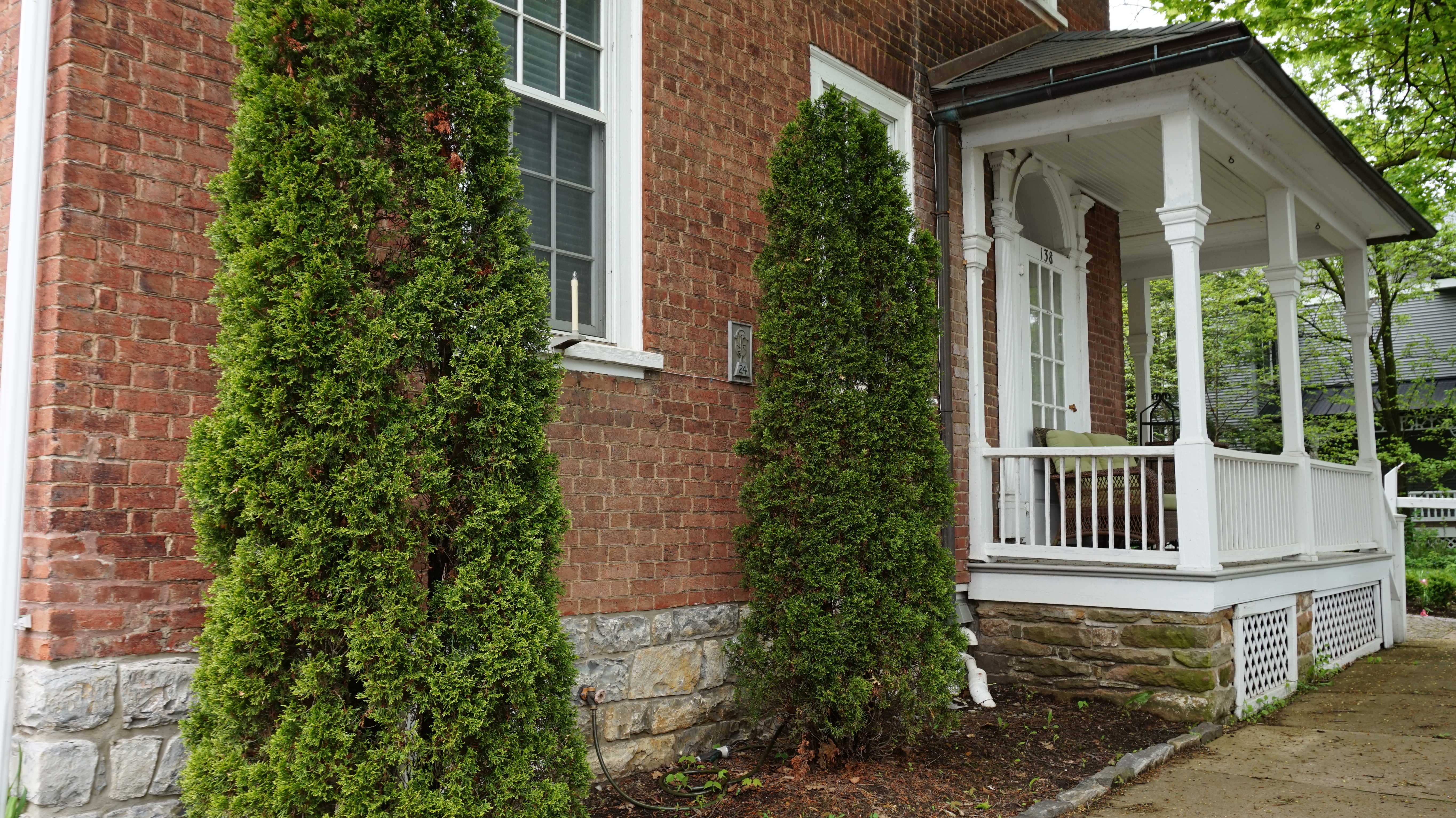
This house was built by John Hess, a hat maker. He first built a 3-story log house on the property, and he and his family lived upstairs above their hat shop while they built this Federal style brick house beginning in 1826. Note the Tuscan fluted pilasters that frame the entrance, the fan-shaped window over the door, and long, rectangular windows on either side. These are all classic Federal – or Adams style – characteristics. The bricks used to build the house were hand formed and fired on the property. The walls are 13 inches thick, and the original hand-made framing and hardware are still in place.
Mr. Hess continued to use the log house as his shop after the brick house was completed. He made fine gentlemen’s felted beaver top hats*. (The Boalsburg Heritage Museum has some of the molds he used to make his hats.) Most gentlemen in a small, rural village needed only one top hat at any one time, which might last them a lifetime, if kept in good condition, so a hatter like John Hess would have needed to do trade far beyond the village of Boalsburg. The ledgers at the company store for Centre Furnace (see Centre County Historical Society) documents that Mr. Hess was selling items there (presumably hats) during the years 1839-1845. John’s son, Adam, carried on the family tradition as hat maker, but by the time Adam’s children were coming of age, gentlemen’s tall hats were going out of fashion. Adam’s daughter, Nellie, married Charles Segner, who converted the old hat making shop to a broom factory. Later still, Charles’ and Nellie’s daughters (Rachael and Ida Segner) operated the town’s first telephone exchange (1920 – 1940) out of the old log house. The log house was razed in 1963
*Felted beaver skin was the preferred material for top hats because of its waterproof properties. Because of the high demand for beaver fashion (men’s coats were also popular), the Victorian top hat practically wiped out the beaver population in America by 1900. [ref: Journal of Antiques & Collectibles. Styling the 19th Century Gentleman by By Maxine Carter-Lome, publisher]. From Wikipedia: “Between the latter part of the 18th century and the early part of the 19th century, felted beaver fur was slowly replaced by silk” top hats. Thus, this fashion pivot from beaver to silk hats around the turn of the century probably helped save our North American beaver population from extinction.
1.22 hm #23 rothrock
Among long-remembered owners are Alla and H.C. Rothrock (professor in the Boalsburg schools), and William Goheen and heirs — Matthew and Mary Goheen, Edwin and Margaretta Goheen Tussey.
1.23 HM #22 Dr. kidder’s house ca. mid-1890’s
126 East Main Street

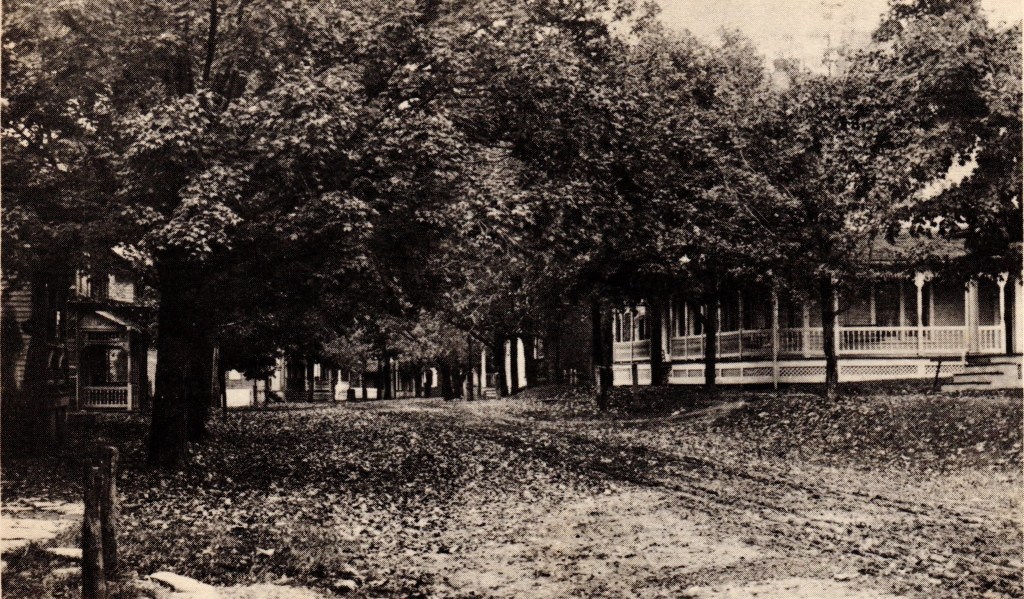
126 East Main Street circa 1912.
This Victorian era house was probably built in the mid-1890’s. It features “gingerbread” porch trim and a “good morning” staircase with steps leading from different sections of the second floor meeting at a landing. The house was purchased by Dr. L. E. Kidder in 1898. Dr. Kidder added a section on the east side of the house (the section to the left of the front door), possibly for his medical practice. This house, along with several other Victorian style houses along this stretch of East Main St., reflects the beginnings of the industrial age when machinery could mass produce wood trim.
The current house sits on the site of an earlier home (ca. 1824-1833) that likely burned down in a fire in 1890 which destroyed about five structures in this block of East Main St., including a general store and the home of David Young, a well-known local gunsmith.
1.24 HM #55 John Jacobs – School Teacher, build date ca. 1900
122 East Main Street

This Victorian home was built about 1900 by John and Effie Leitch Jacobs. Mr. Jacobs was a local school teacher, but also a popular fiddler, which kept him in great demand for dances and parties.
An earlier house existed on this property, but it was destroyed in a great fire in the 1890’s which took out 4 or 5 structures in this section of East Main St., including the George Jack Store, the Post Office, and property of gunsmith, David Young. Fires were common, and the town had not yet acquired a fire truck that could pump water. (Boalsburg got its first pumper truck in 1910, a gift from Theodore [Terry] Davis Boal.)
The small log structure next to this house is not native to Boalsburg. It was moved to this site in about 2005 by the property owner to serve as a visitor kiosk.
1.25 HM #16 Peter Kuhn / Cooper’s shop, built ca. 1840
108 East Main Street
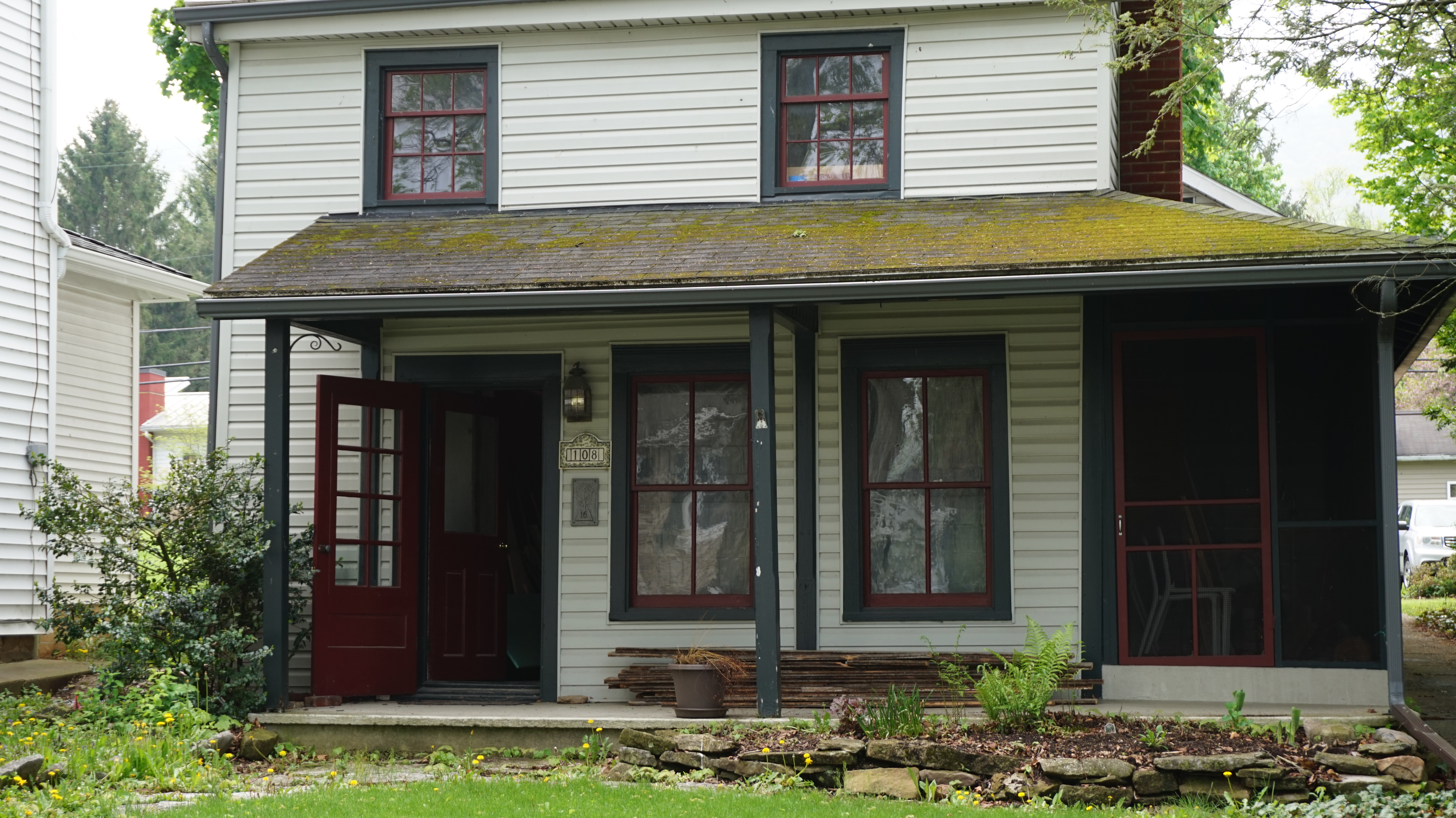
This small frame building was constructed ca. 1840. The 1/8 acre lot once contained a shop and a stable to the rear, in addition to the small house in front. At some point, a section was added joining the small house to the stable, forming a larger residence or shop.
Between 1868 and 1894, the property was owned by Peter Kuhn, a cooper (barrel maker) who also owned a meat and butchering business. Wooden barrels were an indispensable part of American life in the 17th through 19th centuries. They were used for storing both dry goods (e.g., nails, flour, salt, potatoes, salted meats) and wet goods (cider, whisky, beer, oil). According to the Chicago Public Library, “Cooperage, or barrel making, which had long been a hand craft, became highly mechanized as oil production started in Pennsylvania in 1859. The U.S. didn’t have enough barrels to transport all of the oil produced.” So, Peter Kuhn was most likely making hand-crafted barrels at a time when barrel making was becoming automated. We are told his fine hand-crafted barrels were much sought after.
A later owner of this house (around the turn of the century) was Peter Ishler, who is listed in a tax record at the time as a butcher and poultry supplier. After his death, his widow and her sister used the house as their millinery shop (a shop for ladies hats)
The log portion of this house was built over a small cellar, possibly used as a root cellar, which was discovered during recent renovations.

1.26 HM #53 Emma Hunter Stuart – Summer House, original build ca. 1837
102 East Main Street

This house is a combination of German, Georgian, and Victorian influences. The current center gable Victorian home, with tall windows, steep roof, and turned “gingerbread” trim, reflects renovations and features added ca. the late 1880s. An earlier version of this house was owned by George Jack (1837), an early settler of Boalsburg. The walls of the house are made of partially crumbled mud-brick between studs with clapboard siding placed on top. The next owners, George and Elizabeth Jack Boal, had a “large plaster house and stable” when they sold the property to Ezra Brisbin in 1863, who in turn sold it to Brigadier General John S. Brisbin 1867. John Brisbin had served in the medical corps during the Civil War, was a successor to General Custer, and later was in charge of surveying all fences in the United States.
For a time (starting around 1875), this was the home of Emma (nee Hunter) and James Stuart. (Emma Hunter is depicted as a girl of 16 in the “Three Ladies” statue in the Boalsburg cemetery, which commemorates the origins of the Memorial Day tradition of decorating soldier’s graves.) Emma married James Stuart* who operated the Boalsburg Tavern (HM17) for a few years.
When Emma and James first lived in this house, it was an L-shaped plaster farmhouse (no roof gable) with a prominent porch that extended along the entire front of the first floor of the house. The Stuarts opened a drugstore on the east side of the house. It is believed that the change from an L-shaped to a rectangular-shaped house took place around the time of the opening of the drugstore. James and his younger brother John opened a general store in State College in 1882, at which time James closed his Boalsburg drugstore, sold this house, and ceased being tax collector and postmaster in Boalsburg. [Excerpt from Kelley Margolis’ PSU History 302 paper, Dec. 12, 1998]:
Based on tax assessment records, the major renovations that are evident today were most likely carried out under the ownership of George and Lizzie Mickle, who purchased the home in 1887. Emma Hunter Stuart purchased the house (again) in 1910. During this period of her life, Mrs. Stuart owned a home in Bellevue, PA, but she spent her summers in this house in Boalsburg (hence the moniker “Summer House” was used when later owners, The Culbertsons, opened a Bed and Breakfast here in the 1990’s). Emma’s son, William Stuart, and his family lived in one side of the house while Emma was still living there. Emma died in 1935, at which time William’s family took over the entire home. In the era from 1910-1920, the house had the modern conveniences of electric lighting and indoor plumbing, but still used a large decorative stove to heat the front of the house. A large wood burning stove in the kitchen helped heat the back of the house. [Excerpt from Kelley Margolis’ PSU History 302 paper, Dec. 12, 1998]:
*James Stuart was educated at the Boalsburg Academy and went on to become a school teacher and then a clerk for his uncle, George Johnston. During the Civil War, James enlisted into the army as a private, gradually moving through the ranks, finishing his military career as a lieutenant-colonel. In 1873, Col. Stuart became the postmaster and collector of taxes in Boalsburg. He married Emma Hunter in 1875. Mrs. Hunter Stuart became very active in her community by teaching, founding the Civic Club, and taking a major role in the founding of Memorial Day. [Excerpt from Kelley Margolis’ PSU History 302 paper, Dec. 12, 1998]
1.27 HM #15 Col. Johnston House, built ca. 1810
104 West Main Street

This is one of the oldest houses in the village, built ca. 1810 in the earliest days of what was then the town of Springfield. (The town name was changed to Boalsburg in 1820 to honor the Boal family.) Built by James “Colonel” Johnston*, it is of plank construction. The boards were all shaped using hand tools (hand hewn) and hung vertically from a frame. Horizontal lathe boards (to hold the plaster) on the inside walls and horizontal siding outside make a three-layer sandwich.
Col. Johnston and his wife, Hannah Bethesda, lived here during the building of a large stone Tavern (later, Duffy’s Tavern, HM#17), which was completed in 1819. The Johnstons intermittently ran a store or tavern out of this small building while the large stone tavern was being built. (Tax records show that James Johnston owned a store in 1810, then a tavern in 1811 and 1812, and again a tavern in 1814 and 1815.) It is believed that the Johnstons lived here until around 1828 when construction was completed on the “Hill House” (situated on the mountainside above Tennis Alley), which they also built. [PSU History 302W paper, Patrick McLaughlin, Dec. 1998.]
*“Col. Johnston” was actually James Johnston, Jr. (He was not a real Colonel – this moniker came from the fact that his father was a Colonel who commanded the 1st battalion from Cumberland County.) James Johnston’s name comes up time and again on deed transfers in the village. He was a wealthy businessman, owning not only the tavern, but also a saw mill and farmland in the area. He was also a cabinet maker by trade, and owned a cabinet making shop on W. Pine St (HM39). An 1823 tax record shows him owning 150 acres, a store, a tavern, and two houses, along with four lots in Boalsburg. At the time of his death in 1864, he owned over 350 acres of land.
1.28 HM #51 Pool Hall, build date unknown
105 West Main Street

The first use of this property was as a blacksmith shop (ca. 1845-1872) for Joseph Swinehart’s wagon works. The shop had several owners before its purchase by Robert Condo. He and his brothers, Israel and Jacob, fitted rims onto the wheels of heavy wagons. By the turn of the century, this property had an open shed that housed the first pumper truck for the Boalsburg Fire Company. Around 1940, Lynn “Prexy” Platt* of State College purchased the property and established a pool hall here, after years of successfully operating a similar establishment in State College. Prexy’s pool hall was only open in the evenings at first, leaving Mr. Platt time to manage the operation of the Water Company for owner, Claude G. Aikens, and to grow vegetables on a plot near the gate house at the Boal Estate, which he sold to the Tavern, among other customers. The poolroom was a thriving town social hub until Prexy retired in the 1970s. One of the pool tables and a spittoon from the pool hall can be seen on display at the Boalsburg Heritage Museum (HM#62).
*Lynn Platt’s nickname, “Prexy”, was due to the fact that, in his youth, he had been chauffeur for the President of the Pennsylvania State College, Edwin Sparks. In order to be a chauffeur, Mr. Platt had to get certified as a car mechanic, which he did in Geneva, NY in (Date?) His training certificate is on display at the Boalsburg Heritage Museum (HM#62).
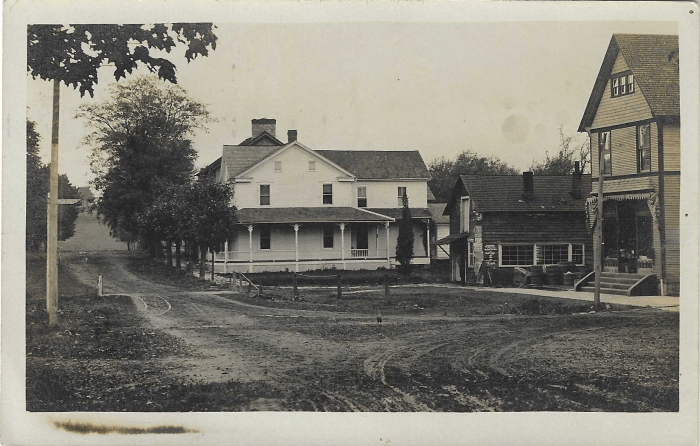
1.29 HM #52 The IOOF building, build date 1895
101 West Main Street

This was one of the larger retail stores in town, built in 1895 by J. H. Weber. Mr. Weber was a merchant* and an “Odd Fellow”, meaning he was a member of the Independent Order of Odd Fellows (IOOF), which was a service organization whose mission was to help the sick and orphaned. He designed the building to have his store downstairs and a lodge for the IOOF members upstairs. The lodge hall had a banquet room with velvet lined benches and a billiard room. The lodge hall was also used by another fraternal organization, the Macabees, which began meeting there in 1902. [PSU History 302W class paper.]

Other store operators in this space include Mr. Weber’s brother, Samuel Weber, W. H. Stuart, A. J. Hazel, the Brouse Brothers, and William Tennis. The one-story addition to the west was added in 1907, possibly to provide additional display space for new factory-made items, such as shoes and gloves. Later, it served as the town Post Office.

*Typically items sold in a general store were not made locally. These were items being brought in from the bigger cities, at first on the stage coach lines, later by train – items, such as fine china, spices, fine fabrics, ribbons, tobacco and medicinal products. But you could also get local meat and produce, nails, farm tools – just about anything, which is why it was called a general store. This would have been one of the fancier general stores in town. The original old counters and pressed tin ceiling can still be viewed today.
1.30 HM# Clover Farm Store
101 East Main Street
For twenty-five years this store, where a loaf of bread sold for eight cents, was owned by storekeepers Fred and Margaret Dale. According to the Centre Daily Times “the grocery on the square in Boalsburg, a landmark for generations of people in Boalsburg closed January 1967”.
 Boalsburg Village Conservancy – 2026
 Historic Boalsburg